
Mole Removal Singapore
Doctor-led assessment and removal of selected moles, skin tags, milia seeds and warts.
Clinic price: From $360 for 1–3 moles, $80 per subsequent mole.
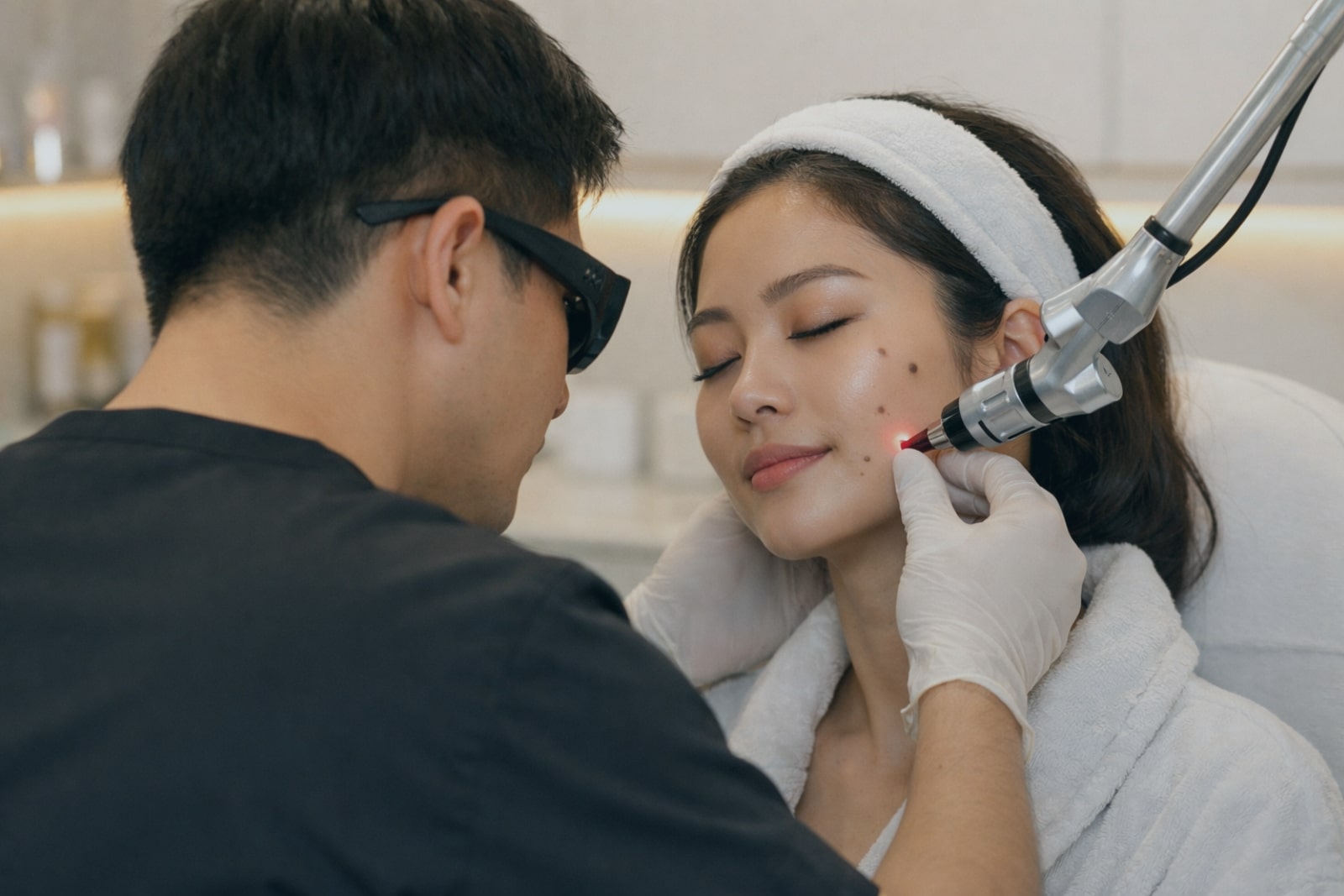

What Is Mole Removal?
Mole removal is commonly sought for cosmetic reasons, repeated irritation, or when a lesion requires closer medical assessment. Before removal, it is important for the lesion to be evaluated by a doctor so that the most appropriate treatment method can be selected.
Not all lesions are managed in the same way. Depending on the type of mole or skin bump, treatment may involve laser removal, electrocautery, shave removal, or surgical excision. Similar methods may also be used for selected skin concerns such as milia seeds, oil seeds, warts, and skin tags.
Potential Benefits of Treatment
- Short in-clinic procedure time in suitable cases
- Removal of selected visible or bothersome lesions
- Option for histology when clinically appropriate
- Doctor-led assessment before treatment
There are both surgical and non-surgical options for mole removal in Singapore. In selected cases, treatment can often be completed within 10 to 15 minutes, with healing and downtime varying according to the lesion type, depth, and treatment approach used.
Key point: Most people have around 10 to 40 moles. If a mole shows changes in asymmetry, border, colour, diameter, or evolution over time, medical review is advisable.
Mole Removal Singapore at a Glance
Treatment Focus
Removal of selected benign moles, skin tags, milia seeds, warts, cherry angiomas, and similar skin bumps after doctor assessment.
Procedure Time
Many cases are completed in a short in-clinic session, although timing can vary based on lesion size, number, and treatment method.
Downtime
Downtime is usually limited, with healing time depending on the depth, location, and whether laser, electrocautery, shave removal, or excision is used.
Suitability Review
A consultation is important to assess the lesion type, check for red flags, and decide whether removal, monitoring, or further testing is more appropriate.
How Are Moles Removed?
Moles develop when melanocytes, the pigment-producing cells in the skin, cluster together. Many are benign and may be suitable for in-clinic removal after doctor assessment. The choice of method depends on the lesion’s size, depth, location, appearance, and whether there is any need for further evaluation.
- Laser removal: Often used for selected small, superficial, or flatter moles where tissue sampling is not required. Some lesions may need a further touch-up depending on depth.
- Shave removal or electrocautery: Suitable for many raised benign-looking lesions and selected superficial skin bumps.
- Surgical excision: More suitable for larger, deeper, or atypical lesions, and may be preferred when laboratory testing of the specimen is needed.
Note on sessions: Many moles are treated in a single visit, although selected laser cases may require 1 to 2 sessions depending on the lesion depth and pigmentation.
Mole Removal Benefits
Mole removal may be considered for cosmetic reasons, repeated irritation, or when a lesion needs closer medical assessment. In suitable cases, treatment can often be done as a short in-clinic procedure.
- Doctor assessment before treatment
- Laser mole removal with a scar-conscious approach in suitable cases
- Minimal downtime for eligible lesions
- Medical aftercare guidance to support healing
Mole Removal Details
- Doctor assessment to identify the mole or skin bump type
- Topical numbing cream is usually applied before treatment
- Suitable laser cases may be completed in about 10 minutes
- Downtime is usually limited, though healing varies by lesion and treatment area
What types of Moles or Skin Bumps can be Removed?
Mole removal may also overlap with the treatment of other common skin bumps and benign-looking lesions. After doctor assessment, suitable cases may include moles, warts, skin tags, milia seeds, cherry angiomas, age spots, and similar superficial growths. Where suspicious features are identified, the priority may shift to further assessment, referral, or excision with lab testing where clinically appropriate.

Cherry Angioma
Small red vascular spots that may be removed when cosmetically bothersome or easily irritated.

Milia Seeds
Tiny keratin-filled cysts that often appear as small white bumps on the face.

Skin Tag
Soft benign growths that commonly form in skin folds or friction-prone areas.

Warts
Viral skin growths that may appear rough, raised, and spread if left untreated.

Moles
Pigmented lesions that may be flat or raised and are assessed before selecting a removal method.

Age Spots
Flat sun-related pigmentation that may be mistaken for other superficial skin lesions.
Get a customised treatment approach at Bio Aesthetic Laser Clinic based on the lesion type, location, and whether cosmetic removal or further medical assessment is more appropriate.
Learn More About Mole Removal
Mole Removal Singapore Details
| Treatment Time | ~10 mins per lesion |
| Results | Often long-lasting; some may recur |
| Sessions | Usually 1; touch-up if needed |
| Recovery | ~1 to 2 weeks |
| Price Guide | From S$360 |
Why Moles Form
Moles develop when melanocytes, the pigment-producing skin cells, cluster together. Their formation is influenced by both genetics and UV exposure.
Sun protection still matters because UV exposure contributes to skin damage and may increase pigment-related concerns. Although not all moles are caused by the sun, daily sunscreen use remains an important part of skin protection.
If a mole changes in shape, border, colour, size, or behaviour over time, medical review is advisable before considering removal.
How to evaluate my mole?
Selected mole and skin bump removal methods may be considered depending on the lesion type, depth, location, and whether tissue sampling is required after doctor assessment.
Mole Removal Treatment Types
Small Flat Moles
Small flat moles may be suitable for laser removal in selected cases, especially when the lesion appears benign and tissue sampling is not required. Treatment suitability still depends on the mole’s depth, pigmentation, and location.
Laser Removal for Small Flat Moles
- May be effective for selected superficial flat lesions
- Usually considered when tissue sampling is not needed
- Downtime is often limited
- Some cases may require touch-up
Raised Protruding Mole
Raised protruding moles are often assessed differently from flatter lesions, as the method chosen depends on how elevated the mole is, whether it is irritated, and whether histology may be appropriate.
Raised Mole Removal
- Often assessed for shave, electrocautery, or excision methods
- Suitable approach depends on lesion shape and depth
- Histology may be considered in selected cases
- Healing varies by treatment method and area
Seborrheic Keratosis
Seborrheic keratoses are common benign growths that may appear waxy, rough, or slightly raised. In suitable cases, they may be treated with laser or other removal methods after doctor assessment.
Seborrheic Keratosis Removal
- Commonly treated when cosmetically bothersome or irritated
- Often suitable for selected non-surgical removal methods
- Usually a short in-clinic procedure in eligible cases
- Doctor review is important to confirm lesion type
Superficial Mole
Superficial moles may be suitable for laser treatment when they appear benign and are located in areas where a less invasive approach is appropriate. Depth and pigmentation still affect treatment planning.
Superficial Mole Removal
- May be suitable for selected laser-based treatment
- Usually planned for lesions with superficial pigment
- Downtime is often limited in suitable cases
- A small number may need further touch-up
Mole Removal Singapore Price
Mole removal in Singapore may start from S$360 for 1 to 3 moles, depending on the lesion type and treatment approach.
| TREATMENT / TYPE | CLINIC PRICE | NOTES |
|---|---|---|
| Laser mole removal (1–3 moles) | SGD 360 | For selected simple cases in the same session |
| Each additional mole | SGD 80 each | Add-on per mole in the same session |
| Surgical excision (per mole) | — | For larger, deeper, or selected lesions requiring a different approach |
Final fees are confirmed after doctor assessment and may vary with lesion size, depth, location, and treatment method.
CONSULT OUR DOCTOR FOR A CUSTOMISED SOLUTION
ASK ABOUT MOLE REMOVALLaser, Electrocautery, or Surgical Mole Excision: What Is the Difference?
Laser, electrocautery, and surgical excision are common mole removal methods in Singapore, with the most suitable option depending on the lesion type, depth, and whether tissue testing is required.
Laser is often considered for selected small, flat moles. Electrocautery is commonly used for raised benign-looking lesions, while surgical excision is usually preferred for deeper, larger, or atypical moles that may need lab testing.
| Comparison | Laser | Electrocautery / Shave | Surgical Excision |
|---|---|---|---|
| Best for | Selected small, superficial, or flat benign-looking moles | Many raised benign-looking lesions | Larger, deeper, or atypical moles |
| Sessions | Often 1; touch-up in some cases | Usually 1 | 1 |
| Downtime | About 1 to 2 weeks | About 1 to 2 weeks | Suture care usually needed |
| Histology | Usually no | May be possible in selected cases | Yes |
| Marks / Scarring | Small flat mark possible | Small superficial mark possible | Linear scar possible |
| Price guide | From S$360 per session | Varies by lesion and method | Varies |
What Are the Different Types of Moles?
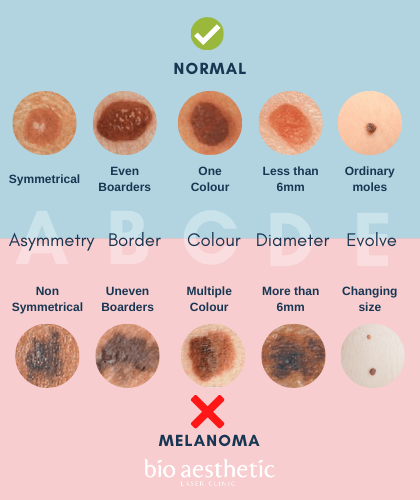
To assess whether a mole needs routine removal or closer medical review, doctors often use the ABCDE guide.
Asymmetry: uneven shape
Border: irregular edges or bleeding
Colour: more than one shade
Diameter: larger than 6 mm
Evolving: changing over time
If a mole changes in size, colour, shape, or starts bleeding, further medical assessment is advisable.
Laser mole removal is commonly considered for selected small, benign-looking moles in Singapore. CO₂ laser treatment ablates superficial tissue under local anaesthesia, with healing often taking about 1 to 2 weeks.
It is often chosen for flat or lightly raised moles when tissue sampling is not required, while deeper or atypical lesions are usually better managed with excision.
Mole Removal Singapore Side Effects
After mole removal, some temporary skin reactions may occur as the treated area heals. Common short-term effects can include redness, mild swelling, tenderness, dryness, and small scabs or crusting at the treatment site.
Less common but possible risks may include prolonged redness, post-inflammatory pigmentation changes, infection, delayed healing, or a small residual mark depending on the lesion type, treatment method, skin response, and aftercare.
A proper consultation, appropriate treatment selection, and careful aftercare can help reduce the likelihood of complications.
Mole Removal Singapore Aftercare Guide
After mole removal, it is common for the treated area to look red and for a small scab or crust to form as the skin heals. The area should be kept clean, protected, and left undisturbed to support recovery.
Healing is usually gradual rather than immediate, and the final appearance of the skin may take time to settle depending on the lesion type, treatment method, and individual skin response.
If you would like to understand the expected healing process, downtime, and aftercare in more detail, you may WhatsApp us to arrange a consultation.
Why Choose Mole Removal in Singapore
Choose the Right Professionals
Choosing professional mole removal in Singapore helps ensure that the lesion is properly assessed before treatment. Mole and skin bump removal is not only about appearance, but also about identifying whether further medical evaluation may be needed.
While non-medical settings may offer quick cosmetic solutions, doctor-led clinics are better placed to assess lesion type, recommend the most suitable removal method, and advise when excision or further testing may be more appropriate.
Professional treatment planning may also help reduce unnecessary procedures, support safer healing, and lower the risk of avoidable complications.
Benefits of choosing professional mole removal:
- Doctor assessment to identify the lesion type before treatment
- Appropriate treatment selection based on depth, location, and clinical appearance
- Access to medical removal methods such as laser, electrocautery, and excision
- Scar-conscious treatment planning, especially for visible areas
- Aftercare guidance to support proper healing
- Option for further testing where suspicious features are present
Am I suitable for Mole Removal?
Mole Removal on Face
-
Male or female, who wants to remove moles
-
Patients are seeking skin cosmetic surgery and removal of skin bumps
-
Scar-minimising approach mole removal
Over‑the‑counter “mole removal creams” are not substitutes for a medical procedure and cannot provide histology. For safety and accuracy, removal should be performed by a trained clinician.Mole Removal Cream Does it work?
Mole Removal Before and After
Frequently Asked Questions
Wait until the surface has re‑epithelialised—often around 1–2 weeks—and your clinician has confirmed it’s safe. Use clean tools and remove gently.
Early on you may see redness and a protective film or light crust. With clean, moist, covered care, the area smooths over 1–2 weeks; the colour blends over several weeks.
No—don’t DIY. Home devices and creams risk scarring, infection and missing out on skin cancer. A clinician should examine the spot and, if needed, send tissue for lab testing.
Not always. Pathology is advised for atypical features or when a sample is taken during excision/shave. Energy‑based ablation usually does not produce a specimen.
Some people develop post‑inflammatory hyperpigmentation, which can leave a lighter patch that often improves over weeks to months. If it continues, please consider discussing options during your review.
Dermatology guidance often prefers plain petroleum jelly to maintain a moist environment and reduce irritation. Topical antibiotics aren’t routinely required and can cause rashes; use only if prescribed.
Elevate your head with extra pillows for a few nights and avoid pressure on the site. A cool compress (not directly on fresh wounds) can help with temporary swelling.
Tell your clinician if you form keloids. Technique and aftercare can be tailored; silicone gel/sheets after closure, sun protection, and avoiding tension/friction can help reduce risk.
Recurrence can happen if pigment or tissue remains, especially after superficial methods. Book a review if you notice regrowth or changes—your doctor will check if a touch‑up or a different method is appropriate.
It depends on the method and whether hair follicles were removed. Some hairs may return over time; if regrowth bothers you, we can reassess or plan a touch‑up.
Mild itch is common as skin heals. Keep the site moisturised with plain petroleum jelly and protected; see us if itch is intense, a rash develops, or there’s increasing redness or pain.
Wait until the wound has sealed and any sutures are out—commonly at least a week. Pools, hot tubs, and saunas increase infection or maceration risk; get the go-ahead at a review.
Avoid strenuous activity or anything that stretches the wound until it seals—often 10–14 days for sutured sites. Light walking is usually fine; stop if there is pain, pulling, or bleeding.
Keep the area dry for the first 24–48 hours unless your clinician advises otherwise. Then shower gently, avoid scrubbing, pat dry, and reapply the dressing/ointment as directed.
Most sites close in about 2–3 weeks, sometimes up to 4 weeks. The face and neck often settle faster; areas under tension (back, legs, chest) can take longer. Mild redness is expected and fades over weeks to months. Always follow the aftercare plan given at your visit.
Short answer: Most sites close in ~2–3 weeks, sometimes up to 4 weeks, with the face often settling faster than areas under tension (back/legs).
-
Expect day‑to‑day activity with mild soreness; follow wound‑care instructions.
-
The redness fades over weeks or months as the scar matures.
For the vast majority of patients, one session would suffice. However, based on the treatment used, certain patients can experience early recurrence and need further sessions to be completely free of the mole.
However, if a mole is found to be cancerous, a formal surgical excision with margins is expected.
For certain moles that are deeply rooted, our doctor will advise performing the mole removal over a few sessions to ensure a lower risk of scarring. We will reassess in a week’s time to determine whether more sessions are required.
To find out more about how to remove moles, you can consult us at www.baclinic.sg/. Find out the price of mole removal in Singapore
Mole Removal Singapore Near You

Tampines Clinic
300 Tampines Avenue 5, #04-05
Income @ Tampines Junction, Singapore 529653
Consult our Doctors

Dr Jolenda Ang

Dr Daniel Khaw

Dr Vijay Sampath
Make an Appointment
Call Us Today! +65 6333 4566 • hello@bioaesthetic.com.sg
Disclaimer: The information on this page is provided for general educational and informational purposes only and should not be relied on as medical, diagnostic, or treatment advice. Content may not be exhaustive, may not apply to every individual, and should not replace a consultation with a qualified doctor. While reasonable care is taken in preparing this content, Bio Aesthetic Laser Clinic and its related parties do not accept liability for any loss, damage, or consequences arising from reliance on the information presented on this page. Suitability for any treatment should always be assessed during a proper medical consultation.