
Double Chin Removal
A double chin can be caused by under-chin fat, loose skin, weaker chin projection, or a mix of factors. That is why the right treatment depends on the actual cause, not just the appearance.
At Bio Aesthetic Laser Clinic, double chin treatment planning is doctor-led and tailored to facial anatomy, treatment goals, and downtime preferences.
Medically reviewed by Dr Vijay Sampath, M.B.B.S, M.S (Gen Surg), DNB (Gen Surg), MRCS (Edinburgh), Royal College of Surgeons – Edinburgh (MRCSEd) • Last updated: April 2026
Key Points at a Glance
If you are searching for how to get rid of a double chin, these are some of the key points patients usually want to know first.
What causes a double chin?
A double chin may be linked to submental fat, skin laxity, genetics, age-related changes, posture, or a weaker chin and jawline structure.
Can you get rid of a double chin naturally?
Weight loss may help if overall body fat is a major factor, but it may not fully improve localised under-chin fullness, loose skin, or a weaker chin profile.
Do double chin exercises work?
Exercises may help with posture and muscle engagement, but they are not considered a reliable way to remove localised fat under the chin.
What is the best treatment for double chin removal?
There is no single best treatment for everyone. The most suitable option depends on whether the main issue is fat, skin laxity, chin projection, or a mix of concerns.
How much does double chin removal cost in Singapore?
Published device pricing may start from S$250 to S$498 per session for selected treatment types, but total cost depends on the treatment plan and whether combination treatment is needed.
Is surgery always needed?
Not always. Some patients may explore non-surgical options first, while others with heavier fullness or looser tissues may benefit from further medical assessment.
Understanding the Concern
Double chin removal refers to the medical or aesthetic management of fullness below the chin, also known as submental fullness. Depending on the cause, treatment planning may involve fat reduction, skin tightening, structural support, or a combination approach.
This is important because not every double chin is caused by the same thing. Some patients mainly have localised fat. Others have mild skin laxity that softens the jawline. Some have a naturally smaller or more recessed chin, which can make under-chin fullness look more obvious.
The goal is not simply to make the area smaller. It is to improve lower-face balance in a way that suits your anatomy and still looks natural.

Patterns and Variations
A double chin is a common lay term for visible fullness below the chin. In medical and aesthetic discussions, this is often described as submental fullness. It can appear as a soft bulge, a less defined jawline, or a heavier transition between the chin and neck.
Some people notice it only in photos or from the side profile. Others find that it becomes more obvious over time with weight changes, age-related skin laxity, or changes in facial structure.
Causes and Contributing Factors
1. Localised fat
Extra fat stored under the chin.
2. Genetics
Inherited facial shape and fat distribution.
3. Skin laxity
Reduced support with age.
4. Chin structure
A weaker chin can make fullness look heavier.
5. Weight changes
Weight gain may worsen the area.
6. Posture
Poor posture can soften the profile.

Different Patterns That May Be Seen
One reason patients get confused is that not all double chins look the same. Identifying the main pattern helps narrow down the most suitable treatment path.
Note: Some patients also notice neck lines or pigmentation in the same area. These can affect how the lower face looks, but they are separate concerns from the double chin itself.

Fat Predominant Double Chin
More common when localised under-chin fat is the main issue and the skin still has relatively good support.

Loose Skin or Laxity Predominant
Often seen when the area looks softer or less defined because skin support has declined over time.

Weak Chin Projection
A smaller or more recessed chin can make the under-chin area appear fuller even without a lot of localised fat.
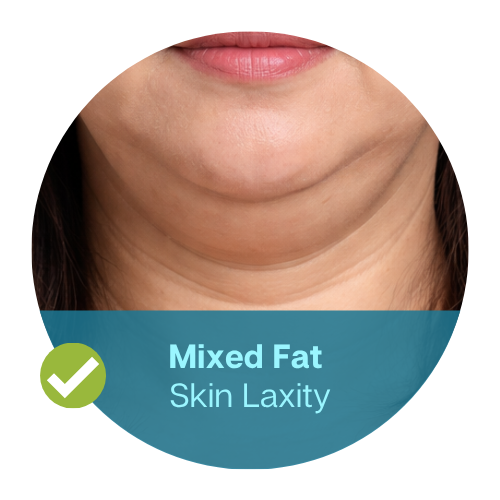
Mixed Fat and Skin Laxity
This is very common. Patients may have both under-chin fat and reduced tissue support along the jawline or neck.

Post Weight Loss Fullness
After weight change, some patients are left with loose tissue or a softer profile even after fat volume improves.

Age Related Lower Face Changes
Jowls, reduced skin firmness, and lower-face volume shifts can make the under-chin area look heavier with age.
How Treatment Direction May Differ
There is no single treatment that suits every patient. The most appropriate option depends on whether the main issue is fat, loose skin, weak chin projection, or a combination of factors.
| Main Presentation | What May Be Discussed | Best Suited For | Notes |
|---|---|---|---|
| Localised under-chin fat | Fat Freeze, selected HIFU planning, Sygmalift in selected cases | Patients whose main concern is fullness rather than loose skin | Assessment is still important because not all under-chin fullness is purely fat |
| Mild skin laxity | HIFU, Sygmalift, selected tightening-focused plans | Patients wanting non-surgical support for a firmer lower-face contour | Usually better for mild to moderate laxity rather than heavy tissue excess |
| Weak chin projection | Chin filler in selected cases | Patients whose profile looks fuller because the chin projects less | This addresses structure rather than removing fat |
| Mixed fat and laxity | Combination planning | Patients with both fullness and reduced tissue support | A single treatment may improve the area only partially |
| Lower-face softening with jaw bulk | Jaw botulinum toxin in selected cases | Patients with stronger masseter muscles who also want lower-face slimming support | This is for muscle-related lower-face width, not direct fat removal |
| Age-related lower-face changes | Thread lift, tightening support, structure-based planning | Patients with softening along the jawline and reduced definition | May be discussed as part of a broader rejuvenation plan |
Treatment Options That May Be Considered
These are some of the treatment paths commonly discussed for double chin concerns. The most suitable plan depends on the cause and whether the main priority is fat reduction, tightening, profile support, collagen support, or a broader lower-face plan.

Sygmalift HIFU
Sygmalift HIFU is for mild under-chin contour concerns where a more comfortable HIFU-style approach is preferred.

HIFU
HIFU is suitable for under-chin contour concerns where tightening support and lower-face definition are part of the goal.

Fat Freeze
Fat Freezing is suitable for patients whose main concern is localised under-chin fat and who want a non-surgical contouring approach.

Chin Filler
Chin filler is considered when weaker chin projection makes the under-chin area look heavier or less defined.

Thread Lift
Consider thread lift when lower-face support, jawline definition, and mild tissue repositioning are part of the treatment goal.

Jaw Botulinum Toxin
Consider masseter botulinum toxin when enlarged masseter muscles contribute to lower-face width and a slimmer jawline is one of the goals.

Injectable Moisturiser
Consider injectable moisturiser when the neck and lower face also show skin-quality decline, fine lines, or reduced firmness.

Liquid PDO Thread lift
Commonly discussed when collagen support, tissue quality, and skin support are part of the overall lower-face or neck treatment plan.

Surgery / Surgical Assessment
May be discussed for patients with heavier fullness, more significant tissue excess, or concerns that may not be optimally addressed by non-surgical treatment alone.
Treatment Costs in Singapore
If you are comparing double chin removal prices in Singapore, the final cost depends on the treatment type, treatment area, number of sessions, and whether a combination plan is needed. Below is a price guide based on currently published Bio Aesthetic treatment pages and currently confirmed publicly available pricing.
| Treatment Option | Published Price | Notes |
|---|---|---|
| Sygmalift HIFU | S$250 | Double Chin / Neck / Eye |
| HIFU | S$498 | Neck + Double Chin |
| Fat Freeze | S$298 | Mini Cup price commonly used for double chin areas |
| Thread Lift | S$1,800 to S$3,000 | Depending on clinic offerings |
| Chin Filler | S$980 to S$1,200 per 1 ml | Depending on brands |
| Jaw Botulinum Toxin | Price not publicly displayed online | Depends on units required |
| Injectable Moisturiser | From $850 | Exact price not publicly displayed online |
| Injectable Moisturiser Neck / Décolletage Add-On | From S$340 | Published 1 ml add-on pricing for neck or décolletage areas |
| Liquid PDO Thread Lift | S$1200 | No currently confirmed public price found |
| Surgery / Surgical Assessment | Contact us | Cost depends on the exact surgical plan and provider pathway |
Note: Prices stated are subject to GST where applicable. Final treatment cost still depends on suitability, the exact treatment area, and whether the plan involves one treatment or a combination approach.
Recovery and Downtime
Downtime can vary depending on the treatment selected, treatment depth, and individual response. A shorter downtime option is not always the most suitable if the main issue is something else.
| Treatment | Typical Downtime Profile | Common Planning Notes |
|---|---|---|
| Sygmalift HIFU | Usually limited | Often discussed for patients who prefer a more comfortable HIFU-style treatment |
| HIFU | Usually limited | Often selected for tightening support and contour planning |
| Fat Freeze | Usually limited | Temporary numbness, tenderness, or swelling may occur |
| Chin Filler | Usually limited | Temporary swelling or bruising may occur |
| Jaw Botulinum Toxin | Minimal in most cases | Results develop progressively over a few weeks rather than immediately |
| Thread Lift | Depends on plan used | Downtime may be more noticeable than device-based treatments |
| Injectable Moisturiser | Usually limited | Small bumps or mild swelling may settle over time |
| Ultracol Liquid PDO | Usually limited to mild injection-related recovery | Temporary swelling, bumps, or bruising may occur depending on plan |
| Surgery / Surgical Assessment | Higher downtime compared with non-surgical options | Recovery profile depends on the exact surgical approach |
Why Combination Treatment Is Often Needed
Many double chin cases are linked to more than one factor. A patient may have under-chin fat, mild skin laxity, or weaker chin support at the same time.
That is why one treatment is not always enough. In selected cases, combination planning may give a more balanced result by addressing the main cause more clearly, rather than relying on a single approach alone.

Not Sure Whether Your Double Chin Is Caused by Fat, Loose Skin, or Chin Structure?
A consultation helps identify the main cause and whether a single treatment or a combination plan is more likely to suit your goals.
What Results Can You Realistically Expect?
Realistic results depend on the cause of the double chin and the treatment chosen. Some approaches are designed mainly to improve skin support. Others are used to target localised fat, stimulate collagen support, or refine the facial profile.
In general, patients may notice:
- a cleaner jawline
- less visible under-chin fullness
- a more balanced side profile
- better lower-face definition
- improved tissue support in selected cases
Some treatments show a progressive response over time rather than an immediate change. In other cases, several sessions or a layered plan may be discussed. Results also depend on anatomy, weight stability, and how much of the concern is caused by fat versus skin support or facial structure.

Why Active Condition Control Matters
If overall weight gain is a major contributor, weight stability can help reduce the appearance of a double chin. However, lifestyle changes alone may not fully resolve the concern when the main issue is localised fat, ageing-related laxity, or chin structure.
This is also why many people feel frustrated after trying diet changes or facial exercises without seeing enough difference. Healthy habits still matter, but they do not solve every type of double chin in the same way.
In some patients, lifestyle measures help support results after treatment, while in others, the under-chin profile is influenced more by anatomy and tissue support than by weight alone.
Prevention and Long-Term Control
You cannot fully prevent a double chin if genetics or facial structure play a strong role, but some measures may help reduce progression or make the area look less obvious over time.
- maintaining a more stable body weight
- protecting the skin from ongoing sun damage
- supporting overall skin health
- paying attention to posture and neck position
- seeking early assessment when lower-face changes first become noticeable
Prevention is usually about slowing down factors that worsen the profile, rather than guaranteeing that the area will never change.

Risks and Side Effects
Side effects vary by treatment type. Some treatments are device-based, while others involve injections, threads, collagen-support injectables, or more invasive procedures.
Common short-term effects that may be discussed include:
- mild swelling
- redness
- tenderness
- bruising
- temporary numbness or firmness in selected cases
The exact side-effect profile depends on the treatment selected and the area treated. A proper consultation is still important to understand what is normal, what to expect during recovery, and when to seek review. More invasive approaches, including surgery, usually involve a more significant recovery profile than non-surgical options.

Questions Patients Often Ask
These are some of the most common questions patients ask about Double Chin Removal, including treatment options, downtime, results, pricing, and doctor-led treatment planning.
A clinic consultation becomes more useful when the concern is persistent, when home methods have not made enough difference, or when it is unclear whether the main issue is fat, loose skin, or facial structure. A doctor-led assessment can help narrow down the cause and the most suitable treatment direction.
Yes. Double chin concerns affect both men and women, and treatment planning is usually based on anatomy, profile shape, and the cause of the fullness rather than gender alone.
Not always. Some patients may do well with a single session and review, while others may need repeated sessions or a combination plan depending on the severity of the concern and the treatment used.
It can, depending on the cause and what happens over time. Ageing, weight gain, and ongoing skin-support changes can all affect the lower-face profile again, even after initial improvement.
Mild swelling can happen after some treatments, but the degree varies depending on the method used. Some patients notice only temporary puffiness, while others may have more visible short-term swelling or bruising before the area settles.
Many non-surgical treatments have limited downtime, so some patients are able to return to normal activities quite quickly. This still depends on the treatment used, how the skin responds, and whether there is temporary swelling, bruising, or tenderness.
Suitability depends more on the treatment chosen, skin condition, and doctor assessment than on ethnicity alone.
In general, treatment selection should be individualised so the method matches the patient’s skin, profile, and recovery needs.
A good candidate is usually someone who is bothered by visible fullness under the chin and wants to explore treatment based on the actual cause.
Suitability depends on whether the concern is mainly fat, loose skin, muscle bulk, or facial structure, as well as the patient’s goals and downtime preferences.
Non-surgical double chin removal usually focuses on fat reduction, tightening support, profile balancing, or collagen support with less downtime.
Surgical treatment is generally more invasive, involves a bigger recovery commitment, and may be considered when the concern is more advanced or when non-surgical options are less likely to be enough.
Exercises may help with muscle engagement and posture, but they are usually not considered enough on their own when the concern is localised fat, skin laxity, or structural profile imbalance. That is why some patients still see limited improvement even after trying home exercises consistently.
Natural approaches such as weight management and posture improvement may help in selected cases, especially if overall body fat is a major contributor. However, they may not be enough when the main issue is localised fat, loose skin, genetics, or chin structure.
That depends on the cause and the treatment chosen. Some options work gradually and are designed to improve the area over time rather than create an immediate dramatic change. The safest or most suitable treatment is not always the fastest-looking option.
Results can be long lasting, but they are not always permanent in the absolute sense. The answer depends on the treatment type, ageing changes, and whether body weight remains stable. Even after improvement, the lower-face profile can still change over time.
Some double chin treatments show a gradual response rather than an immediate change. Depending on the method, patients may notice improvement over the following weeks or months as swelling settles or collagen support develops.
Treatment time depends on the method used, but many non-surgical double chin treatments are commonly completed within about 15 minutes to an hour. The actual session length can vary depending on the treatment area and whether more than one approach is being used.
Comfort levels vary by treatment. Many non-surgical double chin treatments are generally described as tolerable, although patients may still feel temporary discomfort, tenderness, or pressure depending on the method used. More invasive options, including surgery, usually involve a more significant recovery experience.
Consult Double Chin Removal Doctors
Double chin treatment planning is clearer when the cause is assessed properly first. The concern may be linked to fat, loose skin, chin structure, or a mix of factors.
At Bio Aesthetic Laser Clinic, doctor-led consultation helps guide the most suitable treatment direction based on facial anatomy, goals, and downtime preferences.

Dr Daniel Khaw

Dr Justin Goh

Dr Vijay Sampath
Our Clinic Locations
If you are not sure what is causing your double chin, a consultation can help clarify the concern and the most suitable treatment direction.
Orchard Clinic

Palais Renaissance, 390 Orchard Road #03-01, Singapore 238871
View Orchard map
Tampines Clinic

Income @ Tampines Junction, 300 Tampines Avenue 5 #04-05, Singapore 529653
View Tampines map
Speak With Our Clinic Team
If you are not sure whether your double chin is caused mainly by fat, loose skin, lower-face bulk, or chin structure, a consultation can help clarify the cause and the most suitable treatment direction. At Bio Aesthetic Laser Clinic, doctor-led consultation helps patients better understand which treatment options may be appropriate, what downtime to expect, and whether a single treatment or combination plan is more likely to suit their goals.
This site is protected by reCAPTCHA and the Google Privacy Policy and Terms of Service apply.
Explore Related Treatment Options
Sources and Medical References
The references below include general educational sources together with selected peer-reviewed medical journal articles relevant to submental fullness and double chin treatment planning.
- Cleveland Clinic. (2024, August 15). How to get rid of a double chin.
- Harvard Health Publishing. (2018, March 27). Fat-dissolving treatments for a double chin.
- Johns Hopkins Medicine. (n.d.). Double chin surgery: What you need to know.
- Mayo Clinic. (n.d.). Wrinkles: Diagnosis and treatment.
- Deeks, E. D. (2016). Deoxycholic acid: A review in submental fat contouring. American Journal of Clinical Dermatology, 17(6), 607–614. https://pubmed.ncbi.nlm.nih.gov/27785706/
- Shah, G. M., & Rogers, G. S. (2017). Noninvasive approach to treatment of submental fullness. Facial Plastic Surgery Clinics of North America, 25(3), 299–309. https://pubmed.ncbi.nlm.nih.gov/29224033/
Disclaimer: This page is provided for general educational purposes only and should not be relied on as medical advice. Suitability for double chin removal should always be assessed during a consultation with a qualified doctor.