
Wrinkles
Forehead lines, frown lines and crow’s feet that appear or become deeper with facial expression.
Botulinum toxin is a prescription treatment that temporarily reduces activity in selected muscles. It is used when muscle movement is contributing to a line, shape or other muscle-related concern. Whether it makes sense depends on the area being assessed and what is driving the concern.
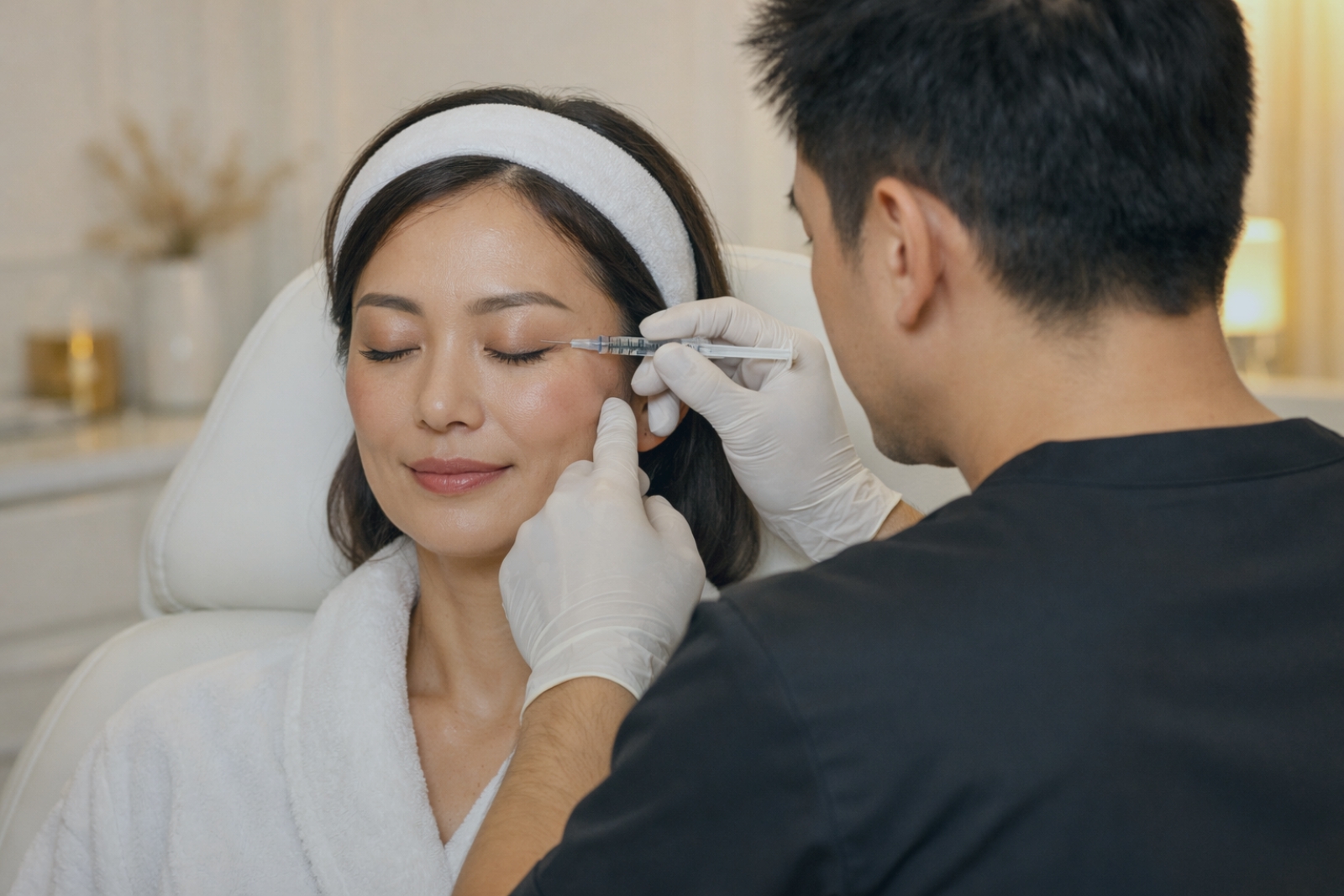
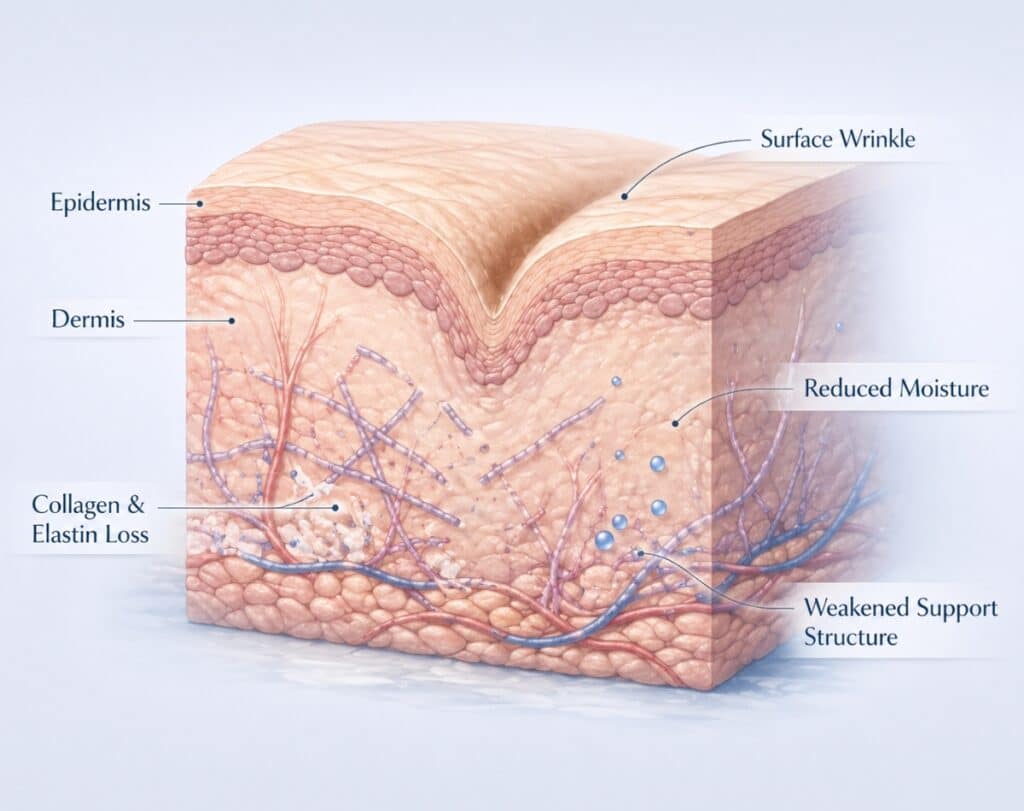
Botulinum toxin makes most sense when muscle movement is part of what you are seeing or feeling. If the issue is mainly skin texture, pigmentation, volume loss, loose skin or facial structure, reducing muscle activity is unlikely to be the whole answer.
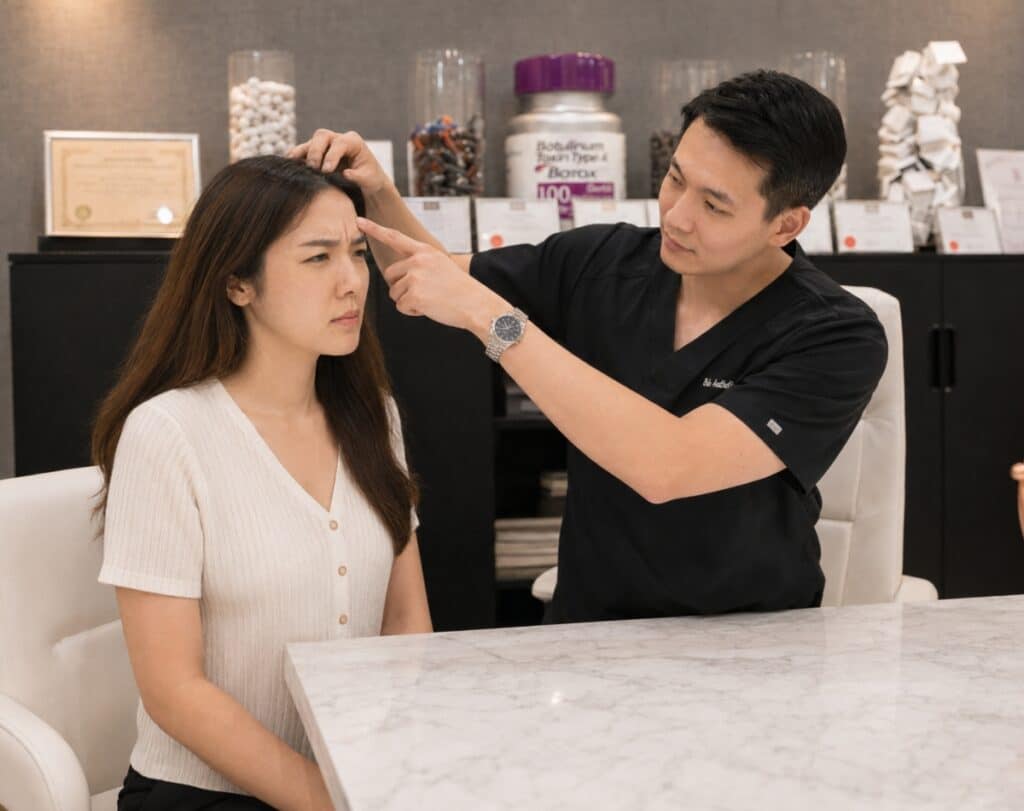
Not sure which applies? The useful first step is to work out what is actually causing the change you notice.
Arrange a consultationA single concern can have more than one contributor. The assessment is used to decide which part, if any, is related to muscle activity and whether changing that activity is likely to help. This is also why the same treatment area does not automatically mean the same treatment plan.
Nerves normally tell muscles to contract by releasing a chemical messenger called acetylcholine. Botulinum toxin reduces the release of that message at the treated nerve endings, so the targeted muscle contracts less strongly for a period of time.
The effect is temporary, and movement gradually returns as nerve signalling recovers.
Nerves normally tell muscles to contract by releasing a chemical messenger called acetylcholine. Botulinum toxin reduces the release of that message at the treated nerve endings, so the targeted muscle contracts less strongly for a period of time.
The effect is temporary, and movement gradually returns as nerve signalling recovers.
Botulinum toxin is best known for wrinkles, but it can also be used when the size or activity of a particular muscle is causing a concern.
Forehead lines, frown lines and crow’s feet that appear or become deeper with facial expression.
When a large masseter muscle is contributing to a wider or squarer lower face.
Selected concerns caused by excessive or unwanted muscle activity, depending on the area and reason for treatment.
Assessment is done with the face at rest and in movement. The doctor checks which muscles are active, how strongly they contract, whether there is existing asymmetry and what movement
Which muscles become active when you frown, raise your eyebrows, smile or clench.
Small differences between the two sides of the face are common and should be noted before treatment.
A visible concern can sit over a muscle without being caused mainly by that muscle.
Relevant medical history, medicines and how you responded to previous treatment can affect the plan.
Assessment is done with the face at rest and in movement. The doctor checks which muscles are active, how strongly they contract, whether there is existing asymmetry and what movement should be preserved. Medical history and previous treatment are also reviewed before a plan is discussed.
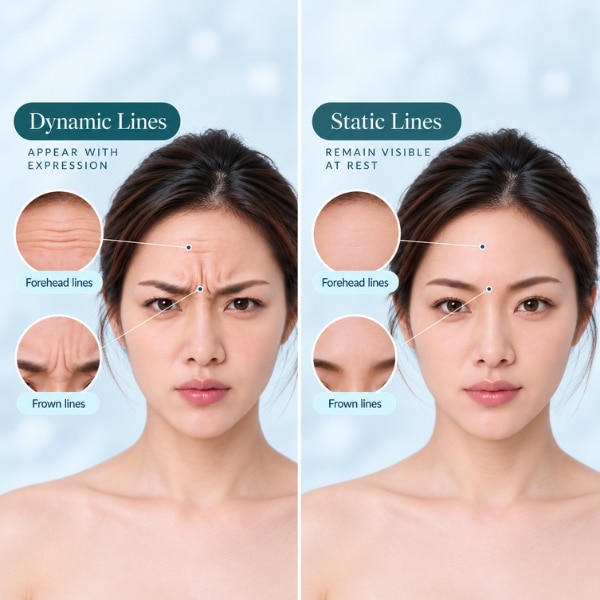
Dynamic lines appear mainly when the face moves — for example when you frown, smile or raise your eyebrows. A line that is still visible when the face is relaxed has become more established
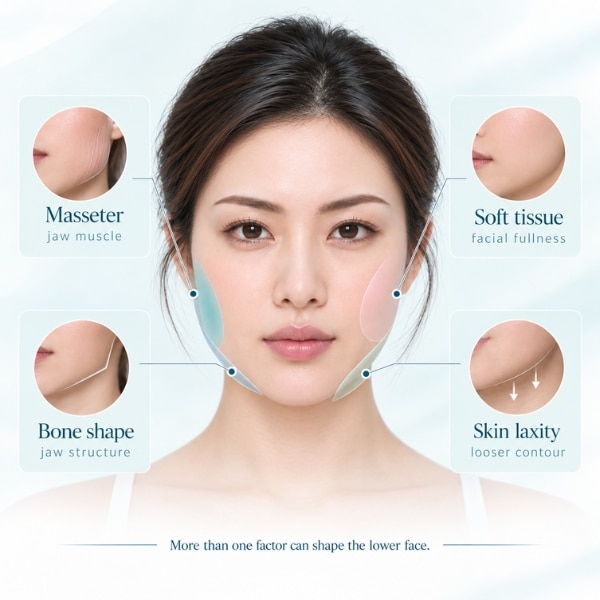
A prominent masseter can make the lower face look wider, especially when the jaw is clenched. But muscle size is only one possible reason. Bone structure, fat distribution and skin laxity can also affect
These are common areas where muscle activity may be relevant. Listing an area does not mean it should be treated; the pattern of movement still needs to be assessed.

Lines between the brows that become more noticeable when frowning or concentrating.

Horizontal lines that appear when the eyebrows are raised, together with brow position and forehead movement.

Lines at the outer corners of the eyes that become more visible when smiling or squinting.

Lines around the sides or bridge of the nose that appear mainly when the nose is scrunched.

A dimpled or uneven chin appearance that becomes more obvious when the chin muscle contracts.

Whether a prominent masseter is contributing to lower-face width, particularly when the jaw is clenched.
An assessment can help work out what is contributing before a treatment direction is chosen.
Most of the decision-making happens before the injections. The consultation brings together your goal, anatomy, movement pattern and medical history before a plan is agreed.
You explain the concern, what you hope to change and any previous treatment or relevant medical history.
The doctor looks at the area at rest and in movement, including muscle activity and any existing asymmetry.
The doctor explains what treatment may realistically change, what it will not change, and the main risks to consider.
If you decide to proceed, the selected areas are treated. Aftercare is explained and follow-up can be arranged when needed.
The appointment begins with a discussion of what you want to change, your medical history and any previous treatment. The doctor then examines the relevant area at rest and during movement.
If botulinum toxin is suitable, the treatment plan is discussed before anything is done. The injection pattern depends on the muscles involved, your anatomy and the effect being considered.
The change develops gradually rather than appearing immediately.
Muscle relaxation is usually clearer by then. Changes in facial contour can take longer.
This is a common range for facial treatment, although the duration differs by area and individual response.
Small injection-site marks, redness, swelling or bruising can occur after treatment.
Movement in the treated muscle may start to feel or look reduced. Some people notice this earlier than others.
The reduction in muscle activity is usually easier to assess once the treatment has had time to settle.
How long it remains noticeable varies with the area treated, muscle activity, formulation and individual response.
The effect does not switch off suddenly. Muscle activity returns progressively as nerve signalling recovers.
Some people begin to notice less muscle movement within the first few days. The effect usually becomes clearer over the following one to two weeks.
What you notice depends on the area being treated. For expression lines, the change is mainly seen when the muscle moves. Changes involving a larger muscle, such as the masseter, can take longer to become apparent.
The response is not identical from one person to another. Muscle strength, anatomy, the area treated, previous treatment and the formulation used can all affect how quickly the change appears and how long it lasts.
Botulinum toxin reduces muscle activity; it does not erase every line or change facial structure. Lines that are already visible at rest may remain, and the effect gradually wears off as nerve signalling returns.
Most side effects after cosmetic botulinum toxin treatment are local and short-lived. Problems can also occur if the effect reaches a nearby muscle, which is why the treatment area, anatomy and injection pattern matter.
Redness, mild swelling, tenderness or bruising can occur around the injection points. Some people also experience a temporary headache.
These effects usually settle without treatment.
Depending on the area treated, unintended muscle weakness can cause effects such as eyelid or brow drooping, facial asymmetry, changes in smile or difficulty fully closing the eye. These effects are uncommon but can last until the treatment gradually wears off.
Allergic reactions and spread of toxin effect beyond the treated area have also been reported, although serious reactions are rare in cosmetic use.
Contact the clinic if you develop a new or unexpected weakness, marked facial asymmetry, significant eye symptoms, or anything after treatment that concerns you.
Seek urgent medical attention for difficulty breathing, swallowing or speaking, widespread muscle weakness, or signs of a severe allergic reaction. These symptoms are rare but should not be watched at home.
Most people can return to their usual day after the appointment. Follow the instructions given for the area treated and contact the clinic if anything unexpected develops.
Keep the injection sites clean and avoid deliberately pressing or massaging the treated area immediately afterwards.
Before treatment, tell the doctor about your medicines, allergies, previous botulinum toxin treatment and any neuromuscular condition. Treatment is generally avoided during pregnancy or breastfeeding, and should not be performed through an active infection at the injection site.
Botulinum toxin is a prescription-only medicine. Regulations in Singapore prohibits public advertising of prescription-only medicines, so we do not publish promotional treatment prices or unit packages on this page. WhatsApp us for more pricing information.
Ask about consultation and clinic fees →Yes. Different preparations are not identical, and their unit numbers cannot simply be compared with one another.

| Patient question | Short answer | What matters |
|---|---|---|
| Does country of origin make one better? | Not by itself. | The specific preparation, evidence, registration and how it is used matter more than whether it was made in Korea, the US or Europe. |
| Are all formulations the same? | No. | Each formulation measures its units differently, so the same number of units does not necessarily mean the same treatment strength. |
| Can the unit numbers be compared? | Not directly. | Units are specific to each preparation, so 20 units of one product should not automatically be compared with 20 units of another. |
| Do they all work exactly the same way? | They share the same basic mechanism. | Clinical dosing, approved uses and supporting evidence can differ between preparations. |
| Is one automatically safer? | No country or formulation can be labelled safest overall. | Safety depends on the actual registered product, treatment area, dose, patient factors and correct administration. |
Country of manufacture alone does not tell you whether a preparation is better, stronger or safer. In Singapore, the more useful questions are whether the product is registered, what clinical evidence supports its intended use, and whether it is being prescribed and administered appropriately.
More than one factor can be present at the same time. This is a guide to the different treatment categories, not a diagnosis.
Different treatments act on different parts of the problem. The choice depends on whether the main driver is muscle activity, volume loss, a change in the skin, or tissue laxity.
Botulinum toxin is unlikely to be the whole answer when muscle activity is not the main reason for the concern. Volume loss, loose skin, pigmentation, scarring and changes in skin texture are treated differently.
More than one factor can be present at the same time. The useful part of the assessment is separating those causes before deciding what, if anything, needs treatment.

We do not start with a treatment and work backwards. The consultation starts with the concern, what is causing it and whether treatment is likely to help. If another approach makes more sense, that should be part of the discussion too.
Treatment planning starts with the concern, anatomy and relevant medical history — not with a fixed treatment menu.
A treatment should not be presented as the answer to every concern. We explain what it can reasonably change, and what it cannot.
Our clinical pages identify the medical reviewer and the sources used for important medical claims.

The part I pay most attention to is what changes when the face moves. Two people can point to the same line or face shape, but the reason behind it may be different. If muscle activity is not the main cause, relaxing the muscle may not give the change the patient expects.
Botulinum toxin is often discussed by treatment area, but I find it more useful to start with the movement.
For example, a forehead line may be strongly driven by repeated muscle contraction, or it may already be visible at rest because the skin has changed over time. In the lower face, a wide jaw may come from a prominent masseter, but bone structure, fat distribution and skin laxity can also affect the shape.
Those differences change the treatment decision. Reducing muscle activity can be useful when the muscle is genuinely contributing, but it should not be expected to correct a problem coming mainly from the skin, volume or facial structure.
I also look at what movement should be preserved. The aim is not simply to make a muscle as weak as possible. The treatment has to make sense for the individual anatomy, the area being assessed and what the patient is actually trying to change.
Short answers first. Open a question only if it matters to you.
Most people describe botulinum toxin injections as brief, mild discomfort rather than significant pain. Sensation varies with the treatment area, number of injection points and individual sensitivity.
The discomfort usually comes from the needle entering the skin rather than from the treatment taking effect. Tenderness can differ between facial areas and larger muscles.
Cooling the skin and other comfort measures may be used where appropriate. Mild injection-site tenderness can also persist briefly afterwards, but significant or worsening pain is not an expected treatment goal and should be discussed with the clinic.
It does not have to. The amount used, where it is placed and how much movement is intentionally preserved all affect the result. The aim should be agreed during the assessment rather than assumed beforehand.
A person who wants very little movement and someone who wants only a subtle reduction may need different treatment plans. There is still a limit to how precisely the final response can be predicted because anatomy and muscle strength differ between people.
Do not judge the result in the first few days. Different muscles can respond at slightly different speeds, and the effect continues to develop over roughly one to two weeks.
If an imbalance is still noticeable once the treatment has settled, contact the clinic for assessment. Depending on what is causing it, the safest option may be to wait, review it again, or make a small adjustment.
There is currently no established routine treatment that immediately switches off cosmetic botulinum toxin. In most cases, an unwanted effect is managed while the treatment gradually wears off.
A small 2026 Phase 1 study reported early proof of concept for a locally injected reversal agent, but this remains investigational and is not standard cosmetic treatment. Specific complications may also have treatments that reduce symptoms while recovery takes place.
Nothing needs to be tapered. As the effect wears off, nerve signalling and muscle movement gradually return. You can simply choose not to repeat the treatment.
The concern that was being treated may become noticeable again as movement returns. That does not mean the treatment has made the original problem worse; it means the temporary effect is no longer being maintained.
Repeated treatment can reduce muscle size and strength for a period of time, particularly when muscle reduction is part of the treatment goal. Whether repeated cosmetic treatment causes permanent structural change is much less certain.
Muscle thinning after botulinum toxin has been documented, but the long-term evidence is limited and varies considerably by muscle, treatment pattern and study design. It would therefore be misleading to promise permanent muscle reduction from repeated treatment.
Yes, different treatment categories can sometimes be combined when they address different contributors to the same concern. They should not be combined automatically, however; treatment sequence and timing depend on the areas involved, the technologies used and the clinical objective.
Some injectable and energy-based treatments can be performed in the same treatment period, but there is no single sequence that suits every combination. Treatments affecting the same area may need more careful timing.
Avoid leaving it until the last minute. Allowing at least two weeks gives the effect time to develop and makes it easier to assess the result before the event.
If it is your first treatment or the event is especially important, a longer buffer is sensible. Bruising can occur, and an unexpected result may need time to settle or be reviewed.
Botulinum toxin is generally not an elective treatment to proceed with during pregnancy when its safety has not been firmly established. Breastfeeding evidence is also limited and should be discussed with the treating doctor according to the specific formulation, indication and circumstances.
A 2026 systematic review found no clear evidence linking exposure during pregnancy with fetal harm, but the authors concluded that the available data were too limited and heterogeneous to establish safety. That is different from proving that treatment is safe during pregnancy.
Yes. Bring up prescription medicines, supplements and any botulinum toxin treatment you have had elsewhere. Some medicines can affect neuromuscular signalling, while others may change your tendency to bruise.
Medicines that interfere with neuromuscular transmission, including certain aminoglycoside antibiotics and muscle relaxants, may increase the effect of botulinum toxin. Other medicines can affect bruising or bleeding around injection sites.
Do not stop prescribed medication simply to have aesthetic treatment. Any change to medication should be discussed with the doctor who prescribed it or the clinician assessing the treatment.
It should not be treated as a routine cosmetic booking for a minor. Any consideration in someone under 18 would need a clear medical reason, an appropriate clinical assessment and the relevant consent arrangements.
Botulinum toxin preparations are prescription medicines, so we keep this public page focused on medical information rather than promotional pricing. Applicable clinic fees can be explained when you enquire or attend an assessment.
Singapore’s regulation prohibits advertisements for prescription-only medicines directed to the public. This is also why this page avoids product promotions, public unit packages and brand-versus-brand sales comparisons.

Tell us what you would like assessed. Our team can help with appointment availability and the next step.

Bio Aesthetic Laser Clinic is a doctor-led aesthetic clinic in Singapore with locations in Orchard and Tampines, offering personalised consultation and treatment planning for a range of face and skin concerns.
We are part of the Theresa Holdings group of healthcare brands.

