
Laser Tattoo Removal Singapore
Lighten or remove unwanted tattoos with doctor-led laser treatment planning.
Laser tattoo removal is usually done over multiple sessions. The treatment plan depends on tattoo colour, ink density, tattoo age, body location, and how your skin responds over time.


What Is Laser Tattoo Removal?
Laser tattoo removal is a doctor-led treatment that uses focused light energy to break tattoo pigment into smaller particles, allowing the body to gradually clear them over time. As this process is progressive, tattoo removal is usually planned over multiple sessions.
At Bio Aesthetic Laser Clinic, laser tattoo removal may be planned with Fotona StarWalker Pico / Q-Switched Hybrid and Q-Switch laser options, depending on tattoo colour, ink density, tattoo age, treatment area, and treatment goals.
Laser tattoo removal may be considered for:
- Unwanted body tattoos that patients wish to lighten or remove gradually
- Partial tattoo fading before a cover-up design
- Selected cosmetic tattoo concerns, including eyebrow tattoo or embroidery correction after assessment
- Multicolour or denser tattoos that require tailored treatment planning
Tattoo response can vary depending on colour, depth, density, professional versus amateur application, body location, and individual skin response.
When carefully planned by a doctor, laser tattoo removal is a non-surgical option to lighten or reduce unwanted tattoo pigment, with treatment staged according to progress and healing.
Laser Tattoo Removal Singapore at a Glance
Treatment Focus
Unwanted body tattoos, eyebrow tattoo removal, and selected cosmetic tattoo correction.
Downtime
Temporary redness, whitening, crusting, or scabbing may happen after treatment.
Session Planning
Usually multiple sessions are needed, with intervals spaced apart for healing and pigment clearance.
Doctor Review
Suitability depends on tattoo colour, density, treatment goal, and individual skin response.
How Does Laser Tattoo Removal Work?
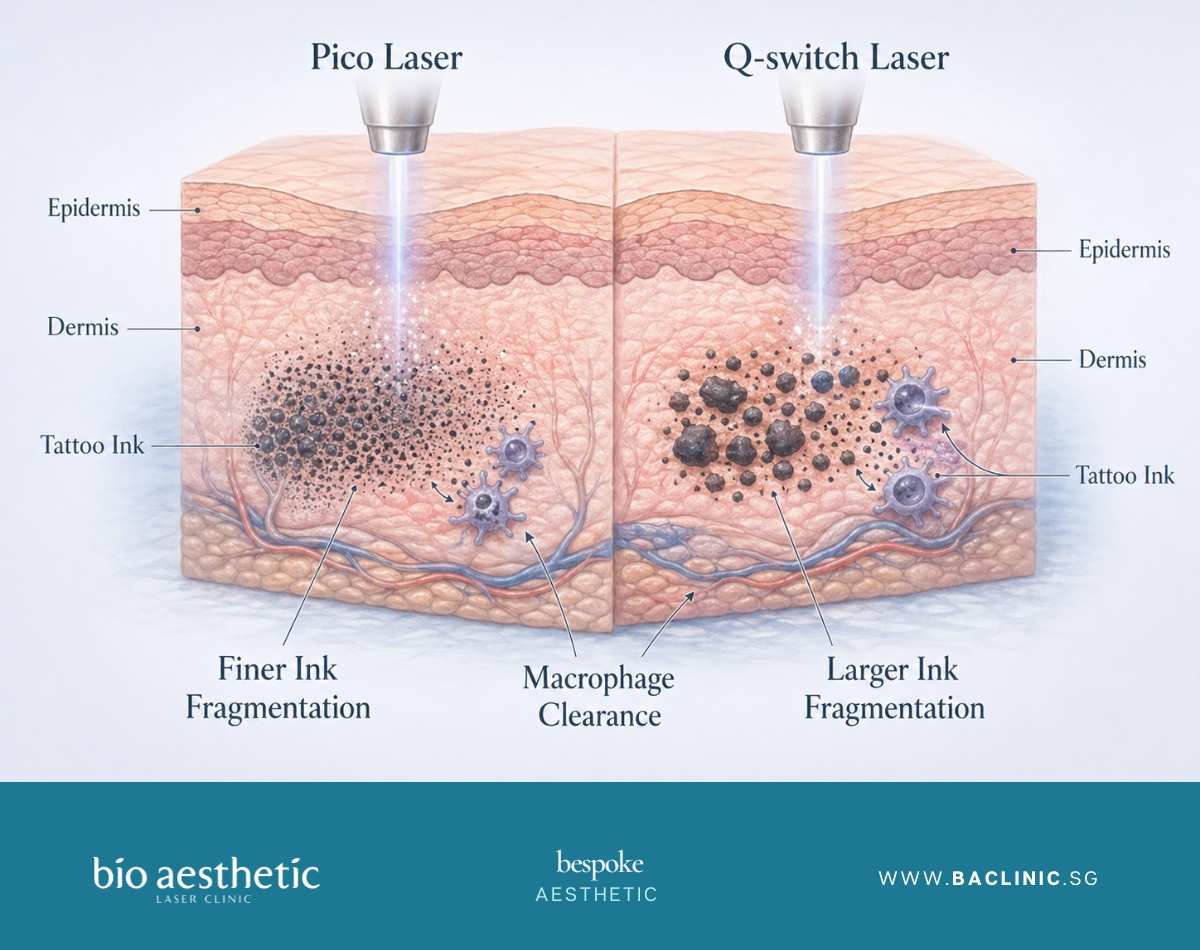
Laser tattoo removal works by delivering short pulses of light energy to the tattoo pigment in the skin.
That energy breaks the ink into smaller particles, and the body gradually clears them over time.
This is why tattoo removal is usually progressive rather than instant and why multiple sessions are often needed instead of a single treatment.
Different tattoos can respond differently depending on the colour, ink density, tattoo age, body location, and whether the tattoo is professional or amateur.
At Bio Aesthetic Laser Clinic, treatment planning may involve a Fotona StarWalker Pico / Q-Switched Hybrid or Q-Switch laser, depending on the tattoo profile and treatment goals.
Because the fading process is gradual, repeat treatment may be discussed as the tattoo lightens over time and the response becomes clearer after each session.
Laser Tattoo Removal Advantages
Laser tattoo removal is commonly discussed for unwanted body tattoos, partial tattoo fading, and selected cosmetic tattoo concerns such as eyebrow tattoo removal.
- unwanted black or dark ink tattoos
- selected multicolour tattoos
- partial fading before a cover-up tattoo
- eyebrow tattoo or embroidery correction
- older or blurred tattoos
- professional or amateur tattoo removal planning
What Happens During the Treatment
- Doctor assessment based on tattoo colour, density, age, and treatment goals
- The more suitable laser option is selected, including Fotona StarWalker Pico Laser or Q-Switched Hybrid
- Laser energy is delivered to fragment tattoo pigment in the skin
- Temporary whitening, redness, or mild crusting may occur after treatment
- Aftercare advice and interval planning are discussed before the next session
Why Patients Choose Laser Tattoo Removal?
Laser tattoo removal is commonly chosen by patients who want to gradually lighten unwanted tattoo pigment, whether the goal is removal, correction, or fading before a new design.

Cosmetic Tattoo Correction
May be considered for selected cosmetic tattoo concerns such as eyebrow embroidery or unwanted pigment where gradual correction is the goal.
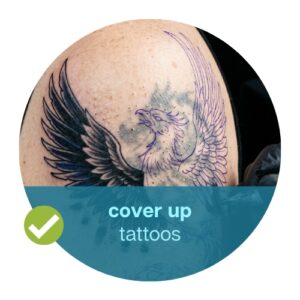
Cover-Up Preparation
Often discussed when the aim is partial fading before a new cover-up tattoo design, rather than complete tattoo removal.
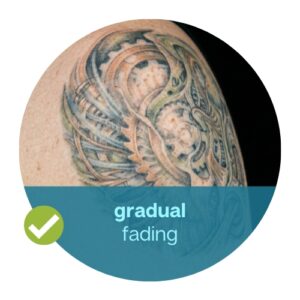
Gradual Fading
Commonly chosen by patients who prefer a staged, non-surgical approach to reducing unwanted tattoo pigment over multiple sessions.
Understanding Laser Tattoo Removal
Laser Tattoo Removal in Singapore
| Treatment Time | 15 to 45 minutes |
| Visible Fading | Gradual over multiple sessions |
| Recommended Intervals | 4 to 8 weeks |
| Recovery Time | Mild to minimal downtime |
| Price | Contact us |
Session planning can vary depending on the tattoo size, colour mix, ink density, body location, and whether the tattoo is professional, amateur, or cosmetic.
When Should You Consider Tattoo Removal?
Laser tattoo removal may be considered when you want to lighten or remove an unwanted tattoo, fade part of a tattoo before a cover-up, or assess selected cosmetic tattoo concerns such as eyebrow embroidery.
Because tattoo removal is usually gradual and often needs multiple sessions, it is generally better to start earlier if your goal is meaningful fading before an event, correction, or cover-up plan.
Whether treatment is suitable depends on the tattoo’s colour, depth, density, treatment area, and the doctor’s assessment.
What Types of Tattoos Can Laser Tattoo Removal Target?
Laser tattoo removal is commonly discussed for unwanted body tattoos, partial fading before a cover-up, and selected cosmetic tattoo concerns where gradual pigment reduction is the goal.
Types of Tattoos for Removal
Black & Dark Tattoos
Black and darker tattoos are often among the more responsive colours in laser tattoo removal planning, although full clearance and treatment response can still vary.

Black Tattoos
- Commonly among the more responsive tattoo colours
- May still require multiple sessions
- Response depends on depth, density, and tattoo age
- Doctor assessment helps guide realistic expectations
Coloured Tattoos
Coloured tattoos may also be treated, although some colours can be slower or more difficult to clear and may need more careful wavelength planning.
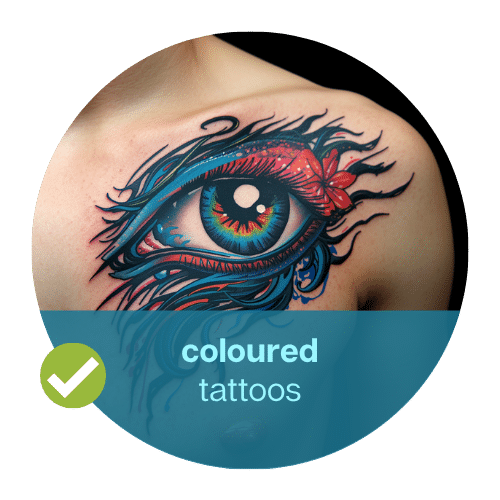
Coloured Tattoos
- May require more tailored laser selection
- Some colours can be more resistant than black ink
- Multicolour tattoos are usually more complex
- Treatment planning depends on pigment mix and density
Cover-Up Preparation
In selected cases, the goal is not full removal, but partial fading before a new cover-up tattoo design.
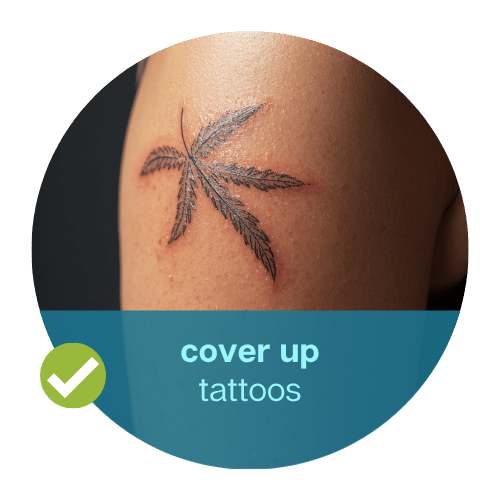
Cover-Up Fade
- Commonly discussed before tattoo redesign work
- The aim may be partial fading instead of full clearance
- Session number depends on how much lightening is needed
- Doctor review helps plan the fading target realistically
Eyebrow & Cosmetic Tattoos
Eyebrow tattoo removal and selected cosmetic tattoo pigments may be considered after assessment, especially where colour shift, old embroidery, or unwanted pigment is the concern.
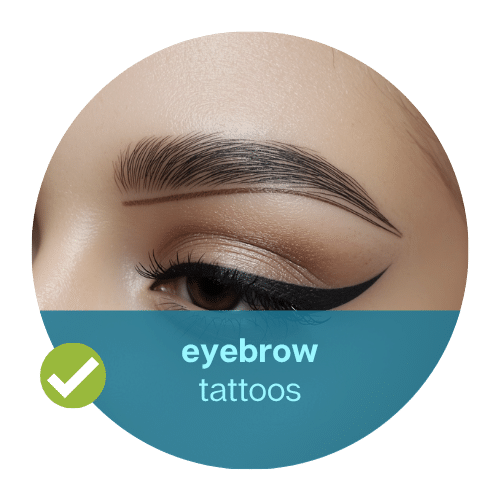
Cosmetic Tattoos
- May be considered for old eyebrow embroidery
- Useful where cosmetic pigment correction is the goal
- Pigment behaviour can differ from body tattoos
- Assessment is important before treatment planning
Old or Blurred Tattoos
Laser tattoo removal is also commonly discussed for tattoos that have faded unevenly, blurred over time, or are simply no longer wanted.
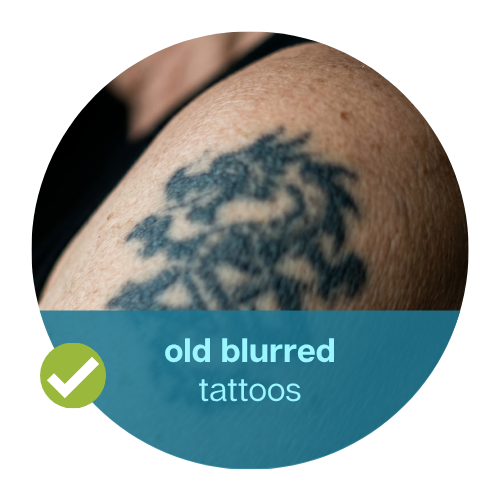
Old or Blurred Tattoos
- May already have some natural fading
- Often discussed when the tattoo no longer suits the patient
- Response still depends on residual pigment density
- Treatment goals may be full removal or partial fading
Professional Tattoos
Professional tattoos are often denser and deeper, which is why they may require more sessions and more careful expectation-setting.

Professional Tattoos
- Often contain denser and deeper ink
- May require more sessions than simpler tattoos
- Multicolour professional tattoos can be more complex
- Doctor-led planning helps guide treatment expectations
Laser Tattoo Removal Singapore Price
Laser tattoo removal costs in Singapore may vary depending on the tattoo size, colour mix, ink density, body location, whether the tattoo is professional or amateur, and the estimated number of sessions required.
After a consultation, your doctor can advise on the recommended laser option, the expected treatment plan, and the associated fees.
If you would like to understand more about laser tattoo removal prices, please contact us for more information.
| Laser Option | Starting Price* | Sessions | Commonly Discussed For |
|---|---|---|---|
| Fotona StarWalker Pico / Q-Switched Hybrid | Contact Us | Multiple sessions | Selected black tattoos, multicolour tattoos, stubborn ink, and selected cosmetic tattoo concerns |
| Q-Switch Laser | Contact Us | Multiple sessions | Selected tattoo profiles, often where darker ink or simpler colour patterns are involved |
We believe in clear treatment guidance so patients can better understand how laser choice and tattoo profile may affect overall treatment planning.
Laser tattoo removal is usually planned over multiple sessions. The exact number of sessions, laser approach, and final fees are determined after consultation and assessment.
CONSULT OUR DOCTOR FOR ANY TATTOO REMOVAL CONCERNS
CONSULT USPico vs Q-Switch for Laser Tattoo Removal
At Bio Aesthetic Laser Clinic, tattoo removal planning can draw on two treatment options: Fotona StarWalker Pico / Q-Switched Hybrid and Q-Switch laser. The aim is not to force one machine on every tattoo, but to choose a more suitable treatment approach based on the tattoo profile, treatment goals, and expected response over time.
| Comparison Point | Fotona StarWalker Pico / Q-Switched Hybrid | Q-Switch Laser |
|---|---|---|
| Technology profile | Pico and Q-switched hybrid flexibility | Traditional Q-switched approach |
| Treatment planning use | Useful when broader flexibility is needed for more complex tattoo profiles | Useful in selected tattoos depending on the treatment plan |
| Clinical role | Allows treatment to be matched more selectively to the tattoo | Remains relevant in appropriately selected cases |
| Planning advantage | Commonly discussed where more flexibility may be helpful | Commonly discussed where a Q-switch approach remains suitable |
Why Having More Than One Laser Option Can Matter
Not every tattoo behaves the same way. Some tattoos may be simpler to plan for, while others may need a more flexible treatment approach depending on the tattoo profile and the degree of fading required.
Having both Fotona StarWalker Pico / Q-Switched Hybrid and Q-Switch laser available in clinic allows treatment planning to be matched more carefully instead of relying on a single fixed option for every case.
For patients, this usually means clearer guidance on treatment direction, session planning, and whether the goal is full removal, gradual fading, or preparation for a cover-up.
How Many Sessions Does Laser Tattoo Removal Need?
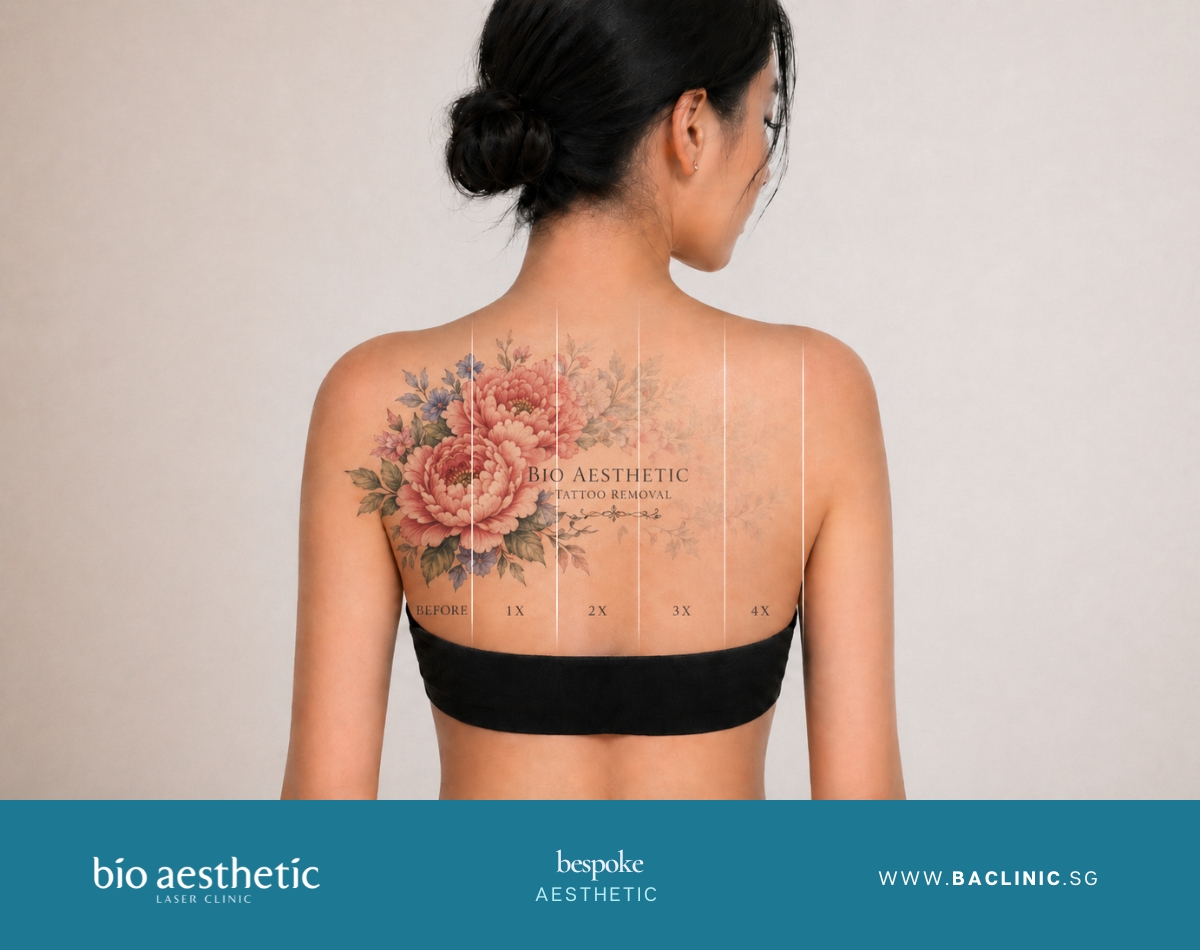
Laser tattoo removal is usually not completed in one session. Most tattoos need multiple treatments because the ink is cleared gradually over time after each session.The number of sessions can vary depending on several factors, including:
- Ink density – denser tattoos usually take longer to fade
- Tattoo age – older tattoos may sometimes respond differently from newer ones
- Skin colour – treatment planning may be adjusted according to skin tone
- Body location – some areas may clear pigment more slowly than others
- Individual skin response – healing and pigment clearance can vary from person to person
Sessions are usually spaced several weeks apart to allow the skin to recover and the body time to clear fragmented pigment.
A consultation is still important to assess the tattoo properly and give a more realistic estimate of the expected treatment course.
*The number of sessions varies from person to person and depends on the tattoo profile and individual response.
Laser Tattoo Removal Singapore Side Effects
Laser tattoo removal is generally associated with temporary, localised skin reactions, but the exact response can vary depending on the tattoo colour, ink density, treatment area, laser used, and individual skin sensitivity.
- Mild redness, warmth, or swelling in the treated area
- Temporary whitening or frosting of the tattoo immediately after treatment
- Tenderness or sensitivity for a few days after the session
- Light crusting, scabbing, or small blisters in selected cases
- Temporary darkening or lightening changes in the skin while healing
- Gradual rather than instant fading, as multiple sessions are usually needed
Because response can differ from person to person, side effects, downtime, and visible fading are best discussed during consultation before treatment planning begins.
Laser Tattoo Removal Singapore Aftercare Guide
After laser tattoo removal, proper aftercare helps support healing and reduces the risk of unnecessary irritation while the treated skin recovers between sessions.
- Keep the treated area clean and dry as advised after the session
- Avoid picking, scratching, or rubbing any crusting or scabbing
- Avoid unnecessary friction on the treated area while healing
- Protect the area from sun exposure and use sun protection when appropriate
- Follow the doctor’s instructions on skincare, dressings, or healing products if these are advised
- Return for review or the next session only at the recommended interval
If the treated area becomes unusually painful, increasingly swollen, or shows unexpected healing changes, it is important to contact the clinic for review rather than self-managing aggressively.
How Tattoo Colour Can Affect Laser Tattoo Removal
Different tattoo colours can respond differently to laser tattoo removal.
Black and darker pigments are often more responsive, while some brighter or mixed colours may take more sessions and more careful planning. This is why colour assessment matters before treatment begins.
| Tattoo Colour | General Removal Consideration | Typical Planning Difficulty |
|---|---|---|
| Black / dark blue | Often among the more responsive tattoo colours | Usually lower |
| Red / orange | May need more careful wavelength selection | Moderate |
| Green / teal / light blue | Often more stubborn and slower to clear | Higher |
| Multicolour tattoos | May need broader treatment planning because colours can respond differently | Usually higher |
Suitability of Laser Tattoo Removal Singapore
Who Is Laser Tattoo Removal For?
- Patients who want to lighten or remove an unwanted tattoo gradually
- Patients who want partial fading before a cover-up tattoo
- Patients seeking assessment for selected eyebrow or cosmetic tattoo correction
How Long Does Laser Tattoo Removal Take?
Laser tattoo removal is usually planned over multiple sessions rather than completed in one visit.
Session number can vary depending on the tattoo profile, ink density, body location, and individual skin response. Treatments are usually spaced several weeks apart to allow healing and gradual pigment clearance.
Laser Tattoo Removal Before and After
Before-and-after photographs cannot be publicly displayed. Please WhatsApp us if you would like more information about treatment expectations, session planning, and whether your tattoo may be suitable for removal or fading.
Laser Tattoo Removal Singapore FAQ
Useful information includes a clear photo of the tattoo, tattoo size, body location, colours used, how old the tattoo is, whether it is professional or amateur, whether it has been treated before, and your goal: full removal, partial fading, or cover-up preparation. This helps the doctor assess the likely treatment direction more accurately.
A cover-up tattoo should only be done after the treated skin has recovered properly and the desired level of fading has been achieved. The timing depends on your healing, the number of sessions completed, and your tattoo artist’s plan. It is best to coordinate timing between the clinic and tattoo artist.
Do not pick, scratch, burst, or peel blisters and scabs. Keep the area clean and follow the aftercare instructions given by the clinic. If the area becomes increasingly painful, swollen, hot, wet, or shows unusual discharge, contact the clinic for review.
It is usually better to avoid heavy exercise, heat, sweating, swimming, and friction over the treated area during the early healing phase. These can irritate the skin or disturb scabbing. Your doctor will advise when it is suitable to return to normal activity based on how the area heals.
Before treatment, avoid tanning, excessive sun exposure, active irritation over the tattoo, and harsh exfoliation on the area. You should also inform the clinic if you are taking medication, have a history of abnormal scarring, or have any skin condition affecting the treatment area.
Most patients describe laser tattoo removal as uncomfortable but tolerable. The sensation is often compared to quick snapping or heat on the skin. Comfort can vary depending on tattoo location, size, ink density, and individual pain tolerance. Numbing options may be discussed before treatment.
Laser tattoo removal is designed to target tattoo pigment, but scarring can still occur in some cases, especially if the tattoo was already scarred, the skin reacts strongly, aftercare is poor, or scabs and blisters are picked. A doctor-led approach helps reduce unnecessary risk and set realistic expectations.
Laser tattoo removal may be suitable for a range of skin tones, including Asian skin, but settings and intervals need to be planned carefully. Darker skin types may have a higher tendency for temporary pigmentation changes, so assessment, conservative settings, and aftercare are important.
Flesh-coloured, white, and skin-tone pigments can be more unpredictable than standard dark ink. Some cosmetic pigments may oxidise or darken when treated with laser. If these colours are present, the doctor may recommend a cautious approach, a test spot, or alternative planning depending on pigment behaviour.
Selected eyebrow tattoo or eyebrow embroidery concerns may be suitable for laser treatment after assessment. Cosmetic tattoo pigments can behave differently from body tattoo ink, and some pigments may darken or shift in colour before they fade. This is why doctor assessment is important before treatment begins.
Black and dark pigments are often more responsive because they absorb laser energy well. Coloured tattoos can be more complex, especially when they contain green, teal, light blue, yellow, white, or mixed pigments. These colours may need more careful wavelength selection and expectation-setting.
Tattoo response varies because not all tattoos are placed, layered, or formulated in the same way. Professional tattoos may contain denser ink, cosmetic tattoos may behave differently from body tattoos, and some colours absorb laser energy less predictably. This is why session planning is personalised.
It is generally better to allow a new tattoo to heal fully before considering laser removal. Treating skin that is still healing may increase irritation and affect recovery. During consultation, the doctor will assess the tattoo age, skin condition, and whether the area is ready for treatment.
Selected partial tattoo removal may be possible, depending on the tattoo design, ink placement, colour, and the precision required. A consultation is important because removing one section while preserving nearby details can be more technically complex than treating the whole tattoo.
Yes. Some patients choose laser tattoo removal to fade a tattoo before a cover-up rather than remove it completely. In these cases, the goal is usually to reduce the intensity of the old pigment so a tattoo artist has more flexibility with the new design.
Laser tattoo removal can help lighten tattoo pigment significantly, but complete removal cannot be guaranteed for every tattoo. The final result depends on ink colour, ink depth, tattoo age, tattoo location, previous tattoo work, and how your skin clears pigment after each session.
Laser Tattoo Removal Near You

Tampines Clinic

Income @ Tampines Junction, 300 Tampines Avenue 5 #04-05, Singapore 529653
Consult our Doctors for Laser Tattoo Removal Singapore

Dr Daniel Khaw

Dr Justin Goh

Dr Vijay Sampath
Make an Appointment
Call Us Today! +65 6333 4566 • hello@bioaesthetic.com.sg
This site is protected by reCAPTCHA and the Google Privacy Policy and Terms of Service apply.
Disclaimer: The information on this page is provided for general educational and informational purposes only and should not be relied on as medical, diagnostic, or treatment advice. Content may not be exhaustive, may not apply to every individual, and should not replace a consultation with a qualified doctor. While reasonable care is taken in preparing this content, Bio Aesthetic Laser Clinic and its related parties do not accept liability for any loss, damage, or consequences arising from reliance on the information presented on this page. Suitability for any treatment should always be assessed during a proper medical consultation.