Forehead and Frown Lines: Anatomy-Based Safety Guide

- Main concern: Forehead lines and frown lines usually involve different muscle groups
- Why anatomy matters: Brow position, eyelid support, and natural asymmetry affect planning
- Main safety goal: Soften lines while keeping upper-face movement balanced
- Important point: The same injection pattern does not suit every face
- Best approach: Conservative, anatomy-led treatment with review after settling
What are forhead lines?

Forehead lines and frown lines are among the most commonly treated upper-face concerns, but they are also the areas where safety planning matters most.
The forehead is not one flat muscle zone, and the muscles that create horizontal lines behave differently from the deeper muscles that pull the brows inward and downward when you frown.
That is why a safe plan is not just about relaxing wrinkles. It is about preserving balanced movement and reducing the risk of heaviness, unevenness, or an overly flat upper face.
Understanding forehead lines botulinum toxin anatomy in Singapore
Upper-face treatment can look simple from the outside because the lines are easy to see. In reality, the planning is much more anatomical than many patients realise. The forehead muscle helps lift the brows, while the frown muscles pull the brows inward and downward. If those opposing forces are not considered together, the face can look unbalanced even if each area was treated correctly on its own.
This is one reason patients often start with a broader guide to botulinum toxin injections in Singapore, then use anatomy-focused articles like this one to understand why forehead and glabella planning needs more nuance than simply treating visible lines.
Forehead lines vs frown lines: what is the anatomical difference?
Forehead lines are usually driven by the frontalis, which is the muscle that lifts the brows and creates horizontal lines when you raise them. Frown lines are mainly created by the corrugator supercilii and procerus, which pull the brows inward and downward when you concentrate, squint, or frown.
Patients often think of this as one wrinkle zone, but it is not. These muscles have different jobs, which is why treatment depth, placement, and dosing strategy are often different too.
| Area | Main muscles involved | Typical expression pattern | Main safety priority |
|---|---|---|---|
| Forehead lines | Frontalis | Horizontal lines when raising brows | Preserve brow lift and avoid heaviness |
| Frown lines | Corrugator supercilii, procerus | Vertical “11” lines and inward brow pull | Reduce strong pull without creating imbalance nearby |
| Combined upper-face treatment | Frontalis + glabellar complex | Mixed movement across brows and forehead | Balance opposing muscle forces carefully |
Why brow position changes the safety plan
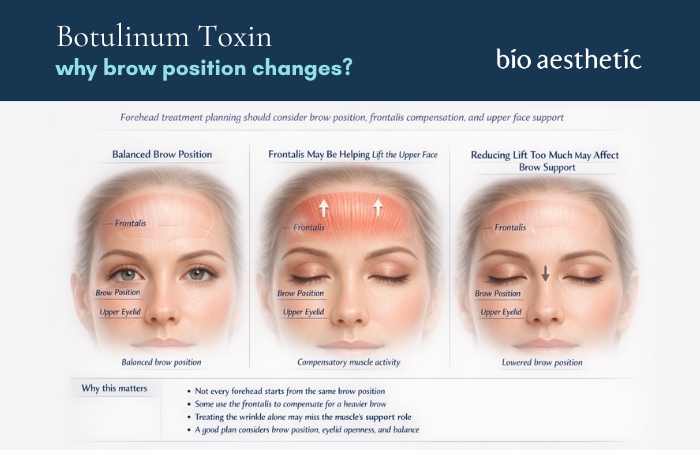
Not every forehead starts from the same brow position.
Some people naturally use the frontalis more because they compensate for a heavier brow, a fuller upper eyelid, or mild asymmetry that they may not notice until treatment is discussed.
In these faces, aggressive forehead treatment can remove the muscle activity that has been helping keep the upper face open.
A good anatomy-based plan therefore looks beyond the wrinkle itself and asks what the muscle is doing for the face, and what may happen if that lift is reduced too much.
Common risks that anatomy-led planning tries to avoid
The goal of anatomy-led treatment is not to make the forehead completely still. It is to soften lines while avoiding issues such as brow heaviness, an unnatural arch, uneven movement, or a result that looks flatter than expected.
These concerns are not always caused by “too much” treatment alone. They can also happen when natural asymmetry or brow support was not properly factored into the plan.
| Potential concern | Why it can happen | How anatomy-led planning helps |
|---|---|---|
| Brow heaviness | Too much forehead lift is removed in a face that relied on frontalis support | More conservative planning and brow assessment before treatment |
| Uneven brows | Natural asymmetry or unequal muscle strength side to side | Side-to-side assessment and conservative balancing |
| Overly flat upper face | Trying to erase all movement rather than soften it | Preserve selected movement where appropriate |
| Unexpected arching | Muscle vectors are not balanced across the brow | Pattern planning based on expression and brow shape |
Who usually needs a more conservative forehead plan?
Patients with naturally low brows, heavy upper lids, strong compensatory forehead movement, or noticeable baseline asymmetry often benefit from a more measured approach.
The same applies to first-time patients who want a very natural result and are more worried about looking heavy or stiff than about removing every line.
In these cases, preserving a little more movement at first can be the safer decision. Refinement at review is usually easier than correcting an upper-face result that feels too heavy.
Why forehead-only treatment is not always enough
Treating the frontalis alone can sometimes make sense, but in many faces, the forehead and frown area behave as one functional unit.
If strong downward pull from the glabellar muscles remains while forehead lift is reduced too much, the result can look heavier rather than smoother.
This is why upper-face planning is often approached as a combined strategy rather than separate line-by-line treatment.
When the focus is on muscle balance rather than just wrinkle visibility, the result usually looks more natural.
Combination planning: when forehead and frown treatment may be considered together
Combination planning can be useful when both the frontalis and frown complex are contributing to the look of the upper face.
This is especially relevant when the patient wants smoother lines without losing balanced brow shape.
The aim is not to weaken every upper-face muscle equally.
It is to decide which muscles should be softened more, which should remain more active, and how the overall expression pattern should look once the result settles.
What a proper assessment should include before treatment
A careful assessment usually looks at brow position at rest, the amount of forehead recruitment during expression, side-to-side asymmetry, how strongly the frown muscles contract, and whether the upper eyelid already looks heavy before anything is treated. Static lines alone do not tell the full story. Movement matters.
From an anatomical standpoint, public educational material also explains that botulinum toxin works by reducing targeted muscle contraction rather than resurfacing the skin itself.
Side effects & safety considerations
Mild redness, swelling, or bruising can happen after treatment and are usually temporary. In the forehead and frown area, however, the bigger safety discussion is often not about bruising alone. It is about whether brow position, movement balance, and expression remain appropriate once the result has fully settled.
If something feels unexpectedly heavy, uneven, or different from what was discussed, that is exactly what the review appointment is for. An anatomy-based approach to forehead lines botulinum toxin treatment in Singapore helps reduce guesswork and preserve natural upper-face balance.
Frequently Asked Questions
Why is forehead treatment considered more delicate than some other areas?
Because the forehead muscle helps lift the brows, and relaxing it too aggressively can affect brow position and upper-face balance.
Are forehead lines and frown lines treated the same way?
No. They involve different muscles and usually need different placement and dosing strategies.
Why do some patients get brow heaviness after treatment?
This can happen when a forehead that already relied on muscle lift is softened too much without enough attention to brow support and anatomy.
Can natural asymmetry affect treatment planning?
Yes. Many faces have baseline asymmetry, and that should be assessed before treatment rather than after it appears more noticeable.
Is it safer to start conservatively?
In many first-time or anatomy-sensitive cases, yes, because it is usually easier to refine than to reverse an upper-face result that feels too heavy.
Why might forehead and frown areas be planned together?
Because the muscles in these areas often work in opposition, and balanced treatment usually looks more natural than isolated treatment in one zone.
What if I want smoother lines but still want movement?
That is a common goal, and it is one reason anatomy-led planning focuses on softening rather than freezing every expression.
Can low brows or heavy eyelids change candidacy?
They do not automatically rule treatment out, but they often mean the plan should be more conservative and carefully tailored.
When is the best time to judge the final result?
Usually after the treatment has had enough time to settle, often around 10 to 14 days.
What should I mention during consultation?
Mention whether one brow feels stronger, whether your eyelids already feel heavy, whether you want natural movement preserved, and whether your concern is forehead lines, frown lines, or both.
Aesthetic Clinic Singapore — Our Locations
Visit our Aesthetic Clinic Orchard or Aesthetic Clinic Tampines for personalised acne scar treatment and comprehensive aesthetic care.
Aesthetic Clinic Orchard

Tel: 6333 4566 | WhatsApp Us
Aesthetic Clinic Tampines

Tel: 6782 2777 | WhatsApp Us
Book a Consultation
Call us at +65 6333 4566 • hello@bioaesthetic.com.sg
Meet Our Doctors


Disclaimer: This article is provided for general educational and informational purposes only and should not be relied on as medical advice, diagnosis, or treatment recommendation. Information may not be exhaustive and may not apply to every individual. A proper consultation with a qualified doctor is recommended to assess suitability, risks, and the most appropriate treatment options for your needs.
About Bio Aesthetic Laser Clinic

Bio Aesthetic Laser Clinic is a bespoke aesthetic clinic in Singapore specialising in doctor-led aesthetic care across acne scars, injectables, skin rejuvenation, and facial concerns.
Need Help?
Have questions about treatment suitability, downtime, or consultation options? Our team is here to assist you.
Signature Treatments