

Rolling acne scars often look like soft “waves” in the skin — but the real issue is usually underneath.
Many rolling scars are tethered by fibrous bands that pull the skin down, which is why surface-only treatments often plateau.
This guide explains the mechanism clearly so you can set realistic expectations.
- Rolling scars are commonly held down by fibrous bands (“tethering”).
- Most surface treatments can improve texture, but they don’t cut the bands.
- Without release, improvements are often mild, temporary, or plateau early.
- Subcision targets tethering directly by releasing fibrous attachments.
- After release, other treatments can become more efficient for refinement.
What Makes Rolling Scars Different
Acne scars aren’t one single category. Rolling scars are typically broad, shallow depressions that create a wavy texture, especially visible under angled light.
Unlike sharp-edged boxcar scars or narrow ice-pick scars, rolling scars frequently involve a deeper mechanical issue: tethering.
What “Tethering” Means
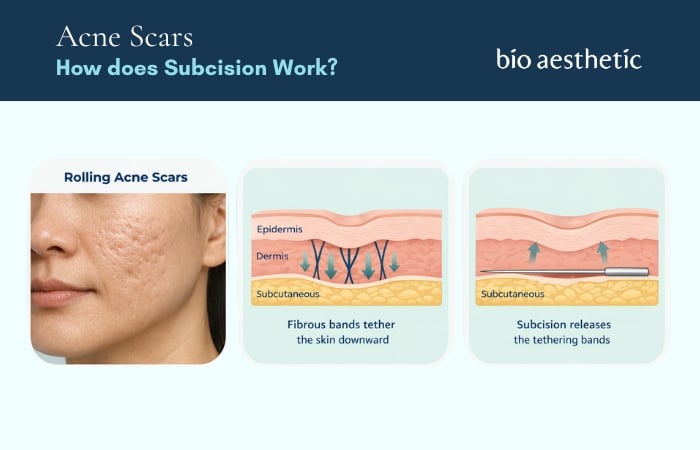
During healing after inflammatory acne, some people develop fibrous strands that connect the skin surface to deeper tissue.
These strands act like tiny anchors. Even if the top layer is smoothed or collagen is stimulated, the anchor can keep the scar pulled down.
Why Surface Treatments Alone Often Stall
Many treatments improve the surface (texture, pores, glow), but tethered rolling scars are a mechanical problem. If fibrous bands aren’t released, the scar can remain depressed even after repeated sessions.
| What You Do | What It Improves | Why Rolling Scars Still Look “Dented” |
|---|---|---|
| Texture-focused resurfacing | Surface smoothness, scar edges | The tether still pulls the skin down from underneath. |
| Collagen stimulation alone | General firmness over time | New collagen forms above the tether, but the anchor remains intact. |
| Repeated sessions without release | Small incremental changes | Returns diminish once surface improvement reaches its ceiling. |
| Immediate “post-treatment glow” | Temporary swelling and plumpness | When swelling settles, the tether can reveal the same depressions. |
Why Subcision Is Different
Subcision is designed to address tethering directly. A fine instrument is used beneath the scar to release fibrous bands that pull the surface down. Once released, the skin can sit closer to its natural level and respond better to refinement treatments.
For the clinical overview and how it’s typically planned, see subcision for acne scars.
External reference (mechanism overview):
Acne Scar Subcision (PMC)
Is Subcision Always Necessary for Rolling Scars?
Not always. Very shallow rolling scars without clear tethering can sometimes improve with texture-focused approaches alone. However, when scars are fixed, deepen with skin stretching, or persist despite resurfacing, tethering is often the limiting factor — and release becomes the logical next step.
Simple Self-Checks That Suggest Tethering
- Side-light test: Rolling dents look deeper under angled light (phone torch from the side).
- Stretch test: If scars deepen or “pull” when skin is stretched sideways, tethering is more likely.
- Plateau history: If you’ve done multiple texture treatments but dents remain, tethering may be the reason.
These are not diagnostic tools, but they help explain why some plans start with release.
Frequently Asked Questions
Is subcision necessary for rolling scars?
If rolling scars are tethered, subcision is often the most direct way to release fibrous bands. Without release, surface treatments may refine texture but struggle to lift the depression itself.
Can lasers remove fibrous bands?
Lasers primarily work from the surface down to improve texture and stimulate collagen. They do not typically cut tethering bands mechanically, which is why tethered scars may plateau with laser alone.
Why do rolling scars look better right after treatment, then sink back?
Temporary swelling can mask depth for a few days. Once swelling settles, a tethered scar may look similar if the underlying band hasn’t been released.
How do I know if my scar is tethered?
Tethered scars often feel fixed, deepen under side light, or show a “pull” when the skin is stretched sideways. A clinical assessment confirms this and maps the best sequence.
Can subcision be combined with other treatments?
Yes. Many plans release tethering first, then use refinement treatments to improve texture and blending, depending on scar pattern and skin response.
Will one session be enough?
Some people see meaningful change after one well-targeted session, while others need staged sessions based on how extensive tethering is and how collagen remodelling progresses.
Putting It Together: Release First, Then Refine
Rolling scars often don’t improve much because the surface is not the whole story — tethering is. Once release is addressed, refinement becomes more predictable and cost-efficient.
Not sure which path fits your scars? See acne scar removal in Singapore (options, sessions & prices) →
/acne-scars-removal/.