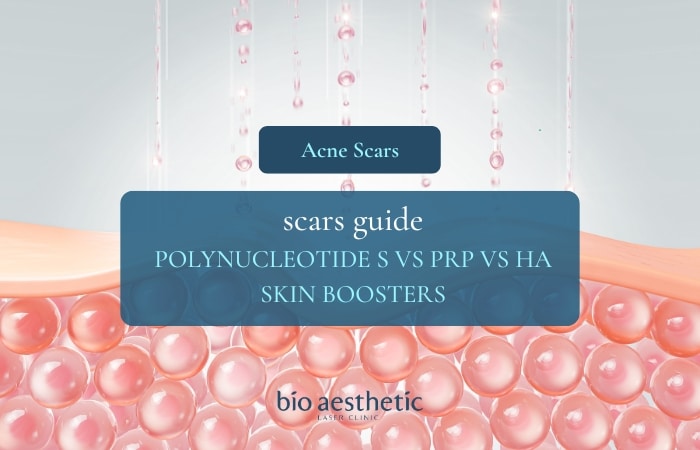
Lasers and subcision often do the heavy lifting for acne scars, but injectable skin remodellers can support healing, collagen production, and texture refinement.
This guide explains how Rejuran S, PRP, and hyaluronic acid (HA) skin boosters differ — and how they fit into an overall scar-remodelling plan.
- 🎯 Rejuran S is a PN-based repair injectable that supports dermal healing and fine atrophic scar remodelling.
- 🩸 PRP uses your own platelets to release growth factors that aid general skin recovery and mild collagen stimulation.
- 💧 HA skin boosters mainly improve hydration and glow; they soften the look of mild unevenness but do not replace core scar procedures.
- 🔗 None of these injectables release tethered scars — they are adjuncts to treatments such as subcision, CO₂ laser and RF microneedling.
- 🧭 Most plans work best when these injectables are combined strategically rather than used alone for deep scars.
Why These Injections Are Adjuncts, Not Stand-Alone Scar Fixes
True acne scars — especially rolling, boxcar and ice-pick scars — involve structural changes in the dermis.
Treatments like subcision and Fractional CO₂ laser are designed to release tethering or resurface the skin in a controlled way to trigger new collagen.
Injectable skin remodellers do not usually replace these modalities. Instead, they tend to:
- Support wound healing and collagen synthesis after structural procedures.
- Improve overall skin quality — hydration, elasticity and fine lines around scars.
- Help fine atrophic scars and textural irregularities appear smoother over time.
For a broader view of how injectables fit with other options, see our overview on acne scar removal in Singapore.
Rejuran S vs PRP vs HA Skin Boosters: Key Differences
The comparison below focuses on how these injections are used as adjuncts for acne scar remodelling, rather than as primary scar treatments.
| Feature | Rejuran S | PRP (Platelet-Rich Plasma) | HA Skin Boosters |
|---|---|---|---|
| Core Mechanism | Polynucleotide (PN) chains support tissue repair and dermal collagen remodelling in scarred skin. | Concentrated platelets release growth factors that promote healing and mild collagen synthesis. | Hyaluronic acid hydrates and provides subtle volumising in the dermis. |
| Main Role in Scar Plans | “Healing” injectable for fine atrophic scars and post-laser or post-subcision recovery. | General skin recovery and quality support; may be layered with other treatments. | Skin quality, glow and hydration; may make shallow scars appear less obvious. |
| Best For | Fine rolling scars, shallow depressions and crepe-like texture around scars. | Patients preferring autologous options; global rejuvenation rather than focal scar repair. | Dry or dull skin with mild textural roughness; patients seeking a “dewy” or “glass skin” look. |
| Typical No. of Sessions | Usually 3–4 sessions, around 3–4 weeks apart, then maintenance if needed. | Usually 3–4 sessions, around 4 weeks apart, then maintenance if indicated. | Often 2–3 sessions, then top-ups every 6–12 months depending on goals. |
| Downtime | Pin-prick marks or small bumps for 1–3 days; mild swelling. | Mild swelling or redness for 1–3 days. | Pin-prick marks and small superficial bumps for 1–3 days. |
| Ideal Combination | After subcision or Secret RF to support collagen remodelling. | After microneedling or lighter laser settings to support recovery. | After core scar work (subcision/laser) to maintain texture and hydration. |
| Position in Treatment Hierarchy | Adjunct; complements mechanical and energy-based scar treatments. | Adjunct; supportive, but usually not sufficient for deep scars alone. | Adjunct; mainly for skin quality and radiance. |
For more detail on PN-based injectables and how they may be incorporated into acne scar plans, you can read our page on Polynucleotide S for Acne Scars.
Biostimulatory vs Platelet vs Volumising: How They’re Classified
Although Rejuran S, PRP and HA skin boosters are all injectable treatments, they belong to different functional categories:
| Type | Example | Category | Primary Effect |
|---|---|---|---|
| Biostimulatory / Repair-focused | Polynucleotide S | PN-based skin remodeller | Supports dermal repair, fine scar remodelling and skin elasticity. |
| Platelet-based | PRP | Autologous growth-factor therapy | Enhances general healing, mild collagen production and skin quality. |
| Volumising / Hydrating | HA Skin Boosters | Hyaluronic acid injectable | Hydrates and subtly plumps; improves superficial texture appearance. |
None of these injectables mechanically release tethered scars — that remains the role of subcision and energy devices such as CO₂ laser or RF microneedling.
Frequently Asked Questions
1. Is Polynucleotide S better than PRP for acne scars?
They work in different ways. Rejuran S is a polynucleotide-based injectable that is often used to support dermal repair and fine scar remodelling. PRP uses your own platelets to release growth factors for general skin recovery. In many plans, Rejuran S is chosen when the priority is targeted remodelling of atrophic scars, while PRP is used more for overall skin health and healing support.
2. Do skin boosters really help acne scars?
Skin boosters can improve hydration and overall skin quality, which may make shallow scars appear less noticeable. However, they usually do not replace core treatments like subcision or lasers. They are most effective as adjuncts layered on top of structural treatments.
3. Can Rejuran S replace CO₂ laser or subcision?
No. Rejuran S does not mechanically release tethered scars or ablate the skin surface. It is generally positioned as a supportive treatment alongside procedures such as subcision, CO₂ laser or RF microneedling.
4. How many sessions of Rejuran S or PRP will I need?
Most protocols involve a series of about three to four sessions, spaced a few weeks apart, followed by maintenance if needed. The exact number depends on scar severity, concurrent treatments and how your skin responds.
5. Are HA skin boosters the same as dermal fillers?
Both contain hyaluronic acid but are used differently. HA skin boosters are injected more superficially and widely to improve hydration and glow. Dermal fillers are placed more strategically and deeply for structural lift or contour.
6. Can I combine Rejuran S or PRP with lasers?
Yes. A common approach is to perform fractional CO₂ laser or RF microneedling first to create controlled micro-injuries, then use Rejuran S or PRP afterward to support healing and collagen remodelling. Timing is customised by your doctor.
7. Which injectable option is safest for darker skin?
Injectables such as Rejuran S, PRP and HA skin boosters are generally suitable for a wide range of skin tones. The higher pigmentation risk usually relates to energy-based procedures and settings rather than to injectables themselves. A personalised plan helps match the combination to your skin type safely.
8. How quickly will I see results from these injectables?
Hydration and plumping from HA skin boosters can appear within days. Collagen-related changes from Rejuran S or PRP tend to be more gradual, building over weeks to months, especially when combined with other acne scar treatments.
Fitting Injectables into Your Acne Scar Plan
Rejuran S, PRP and HA skin boosters are best thought of as supporting players in acne scar management. They enhance repair, hydration and long-term skin quality after core procedures like subcision and lasers.
- Not sure which path fits your scars? See acne scar removal in Singapore (options, sessions & prices).
- Explore core modalities often combined with injectables: Subcision, Fractional CO₂ Laser and Secret RF Microneedling.
This article is for educational purposes and does not replace a personalised consultation. Suitability, number of sessions and outcomes vary depending on scar type, skin condition and treatment combination.
Doctor reviewed by Dr Vijay Sampath, M.B.B.S, M.S (Gen Surg), DNB (Gen Surg), MRCS (Edinburgh). Last reviewed: December 2025.