Not all “acne scars” are the same. Some scars are depressed (atrophic) and some are raised (hypertrophic or keloid). These represent different scar biology — which means the treatments that help are different too.
- Atrophic scars (rolling/boxcar/ice-pick) sit below the skin surface and often need collagen remodelling and scar-release strategies.
- Hypertrophic scars are raised but stay within the original acne boundary.
- Keloids are raised and can grow beyond the original acne lesion.
- Tools that help atrophic scars may not help raised scars — and can sometimes irritate them.
- Raised-scar management is usually about calming overactive scar tissue, not resurfacing the surface.
Keloid vs Acne Scar Difference: Raised vs Depressed
When people say “acne scars,” they often mean atrophic scars — depressed scars caused by collagen loss after inflammation.
These include rolling, boxcar and ice-pick scars.
Raised scars are different:
- Hypertrophic scars: raised scars that remain within the boundary of the original acne lesion.
- Keloids: raised scars that extend beyond the original lesion and may keep growing over time.
This difference matters because the problem is opposite: atrophic scars have too little collagen structure in the right places, while raised scars represent overactive scar tissue.
Treatment Suitability Chart: What Helps Which Scar Type
| Tool / Approach | Atrophic Acne Scars (Depressed) | Hypertrophic / Keloid (Raised) | Why |
|---|---|---|---|
| Subcision | Often used for tethered rolling scars | Generally not used | Subcision releases tethering (depressed scars); raised scars are not tethering problems. |
| Fractional CO₂ laser | Often used for texture and scar edge blending | Selective / case-dependent | CO₂ helps remodelling for atrophic scars; raised scars need careful selection to avoid irritation. |
| RF microneedling | Can support collagen remodelling for texture | Selective / case-dependent | May help some raised scar patterns, but requires conservative planning and close follow-up. |
| Steroid injections (intralesional) | Not a standard option | Commonly used | Helps reduce overactive scar tissue and flatten raised scars over time. |
| Silicone gel / silicone sheets | Limited role | Often used as support care | Supports scar maturation and reduces excessive scar activity in some cases. |
| Pressure avoidance / friction control | Helpful but not primary | Important | Repeated irritation can worsen raised scar behaviour. |
Note: suitability can vary. Raised scars need careful assessment because some interventions can trigger inflammation.
Raised Acne Scars: What “Management” Usually Means
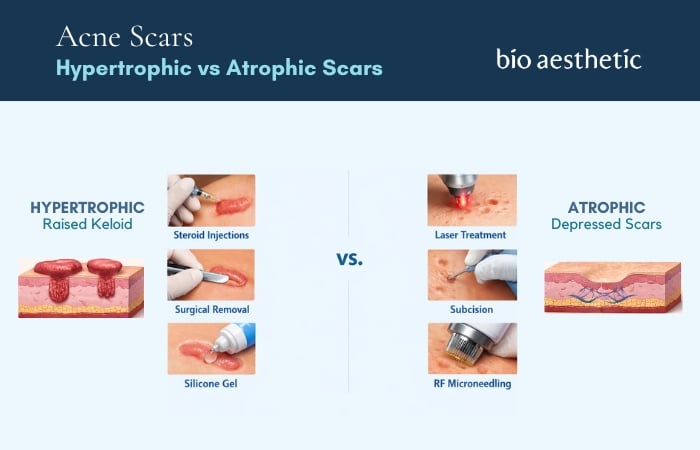
Raised scars are typically managed by calming the scar tissue rather than resurfacing aggressively. Common medical approaches may include:
- Intralesional steroid injections (to reduce thickness and itch/tenderness)
- Silicone-based scar care as supportive management
- Trigger control (friction, picking, repeated irritation)
This article keeps raised-scar scope intentionally narrow because treatment choice depends heavily on scar behaviour, location (e.g., chest/shoulders), and individual risk of recurrence.
Can Laser Remove Keloids?
Lasers are not a “one-step removal” solution for keloids. In some cases, certain laser approaches may help symptoms (like redness) or support remodelling as part of a broader plan, but keloids are known for recurrence and need cautious, personalised management.
If your main concern is depressed (atrophic) acne scars, your options and planning framework are different. See acne scar removal in Singapore (focused on atrophic scars) for a structured overview.
Frequently Asked Questions
Can laser remove keloids?
Laser is not typically a single-step “removal” for keloids. Keloids often require a cautious plan and can recur. Some laser approaches may help specific features (like redness) in selected cases, but suitability varies.
What is the keloid vs acne scar difference?
Atrophic acne scars are depressed due to collagen loss. Keloids are raised scars that extend beyond the original acne lesion and represent overactive scar tissue.
Are hypertrophic scars the same as keloids?
No. Hypertrophic scars are raised but stay within the original lesion boundary. Keloids extend beyond it and may continue growing.
Do steroid injections help raised acne scars?
They may. Intralesional steroid injections are commonly used to reduce raised scar thickness and symptoms like itch or tenderness. They typically require multiple sessions.
Can atrophic-scar treatments make raised scars worse?
In some cases, yes. Aggressive resurfacing or irritation can inflame raised scars. That’s why raised lesions need careful assessment before any energy-based treatment.
How do I know if my scar is raised or depressed?
Raised scars are elevated above surrounding skin and may feel firm. Atrophic scars sit below the surface and create shadows in angled light. A clinical assessment confirms scar type and safest options.
Next Step: Identify the Scar Type First
Raised scars and depressed scars require different tools entirely. If your main concern is atrophic acne scarring (rolling, boxcar, ice-pick), use a plan built for collagen remodelling and scar-release strategies.
Not sure which path fits your scars? See acne scar removal in Singapore (options, sessions & prices) → /acne-scars-removal/.
Doctor reviewed by Dr Vijay Sampath, M.B.B.S, M.S (Gen Surg), DNB (Gen Surg), MRCS (Edinburgh). Last reviewed: January 2026.