

Budgeting acne-scar treatment isn’t about picking the cheapest option — it’s about sequencing the right steps first so you don’t waste sessions.
This guide helps you prioritise based on scar structure, expected impact per phase, and budget tiers (without repeating a pricing table).
- Start by treating the main limiting factor (tethering or depth) before “polishing” texture.
- Over-treating often happens when resurfacing is done before tethered scars are released.
- Under-treating happens when only low-impact maintenance is used for deep scars.
- A staged plan with checkpoints is usually more cost-effective than repeating mild sessions blindly.
- Use your cost guide to compare within a phase — not to decide the phase order.
Why People Overspend (or See Little Improvement)
Most budget “mistakes” are actually sequencing issues. When the order is wrong, you can spend more and still feel stuck.
- Repeated texture treatments while scars remain tethered
- Stacking multiple low-impact sessions instead of fewer targeted phases
- Jumping into advanced resurfacing without confirming scar type
- Stopping too early, before collagen remodelling has time to show (often weeks to months)
The Core Rule: Treat the Limiting Factor First
Every acne-scar plan has a “limiting factor” — the single issue that blocks visible improvement. Treat that first, and everything that follows becomes more efficient.
- Tethered rolling scars: release first, then refine
- Deep boxcar scars: structural correction before surface polishing
- Mixed scars: staged combination (release → resurface → refine)
- Mainly mild texture: resurfacing may be the main phase
For a full overview of options, sessions and planning, see acne scar removal in Singapore.
Decision Tree by Budget Tiers (Prioritisation Logic)
This matrix helps you sequence treatments by budget level without jumping into unnecessary steps too early.
| Budget Tier | Primary Goal | Prioritise First | Defer Until Later | Checkpoint to Reassess |
|---|---|---|---|---|
| Starter / Limited | Avoid under-treating; get maximum impact per step | Scar typing + target the main structural issue (often tethering) | Repeated mild “polishing” sessions with small per-session impact | After the first structured phase (4–8 weeks post) |
| Moderate | Visible improvement without overspending | Structural correction → resurfacing/texture phase | Finishing steps (skin boosters, micro-refinement) | After 2–3 sessions of the main modality |
| Flexible / Phased | Optimise outcome over time | Staged combination plan (release → resurface → refine) | Overlapping multiple modalities in the same time window | Every phase completion before adding the next layer |
Note: this is sequencing logic, not a pricing guide. Session counts and spacing depend on scar pattern and skin response.
Where Subcision and CO₂ Fit (From a Budget Perspective)
Two modalities commonly discussed in cost-effective sequencing are:
- Subcision for tethered rolling scars: often high value when tethering is the limiting factor because it removes a mechanical barrier to improvement. Learn more: subcision for acne scars.
- Fractional CO₂ for texture and scar edge blending: often becomes more cost-effective after structural issues are addressed. Learn more: fractional CO₂ laser for acne scars.
In practice, fewer targeted sessions in the right order can outperform many low-impact sessions done out of sequence.
How to Avoid Over- and Under-Treating
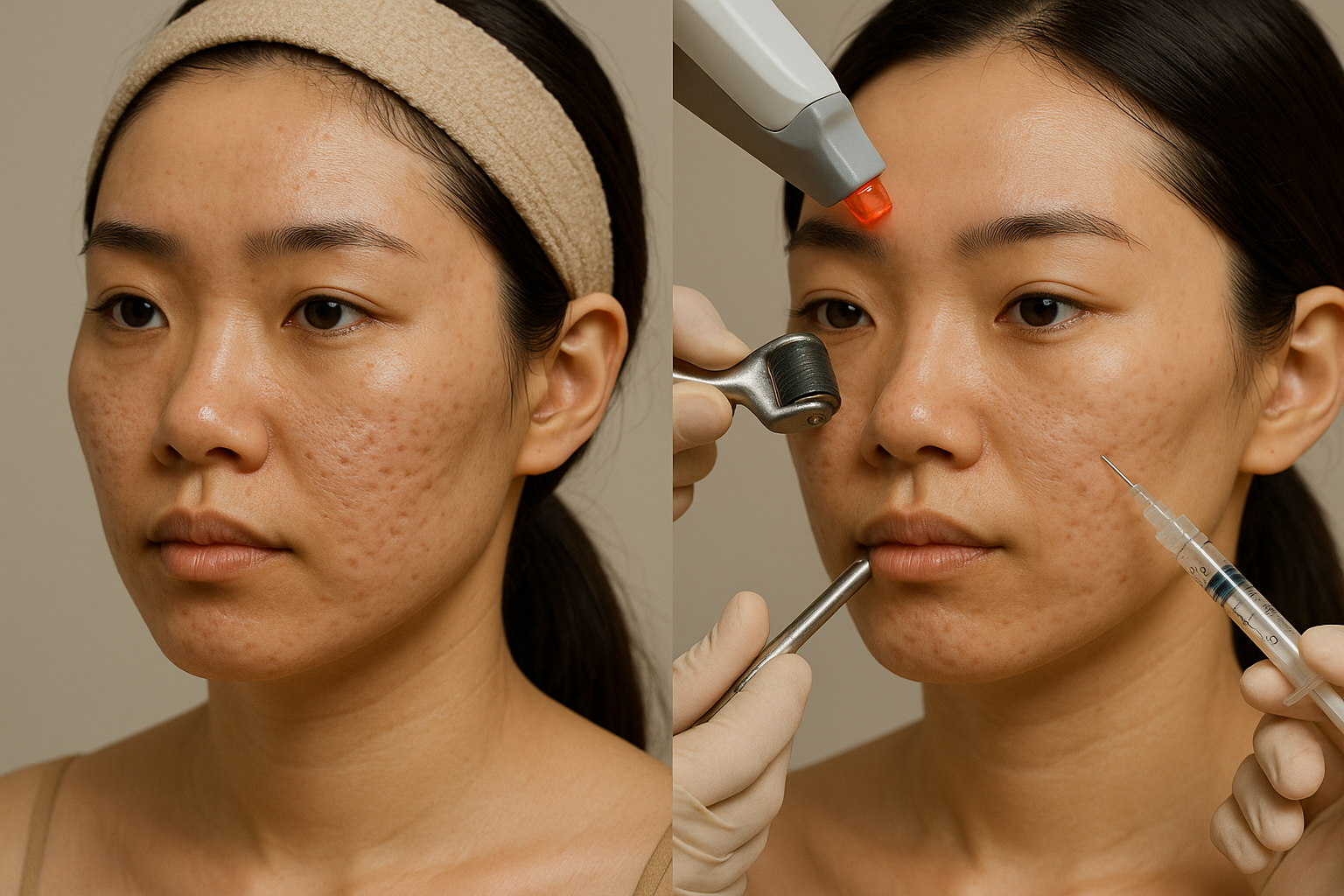
Signs you may be over-treating
- Frequent sessions with minimal incremental change
- Multiple overlapping modalities without a review checkpoint
- “Polishing” texture while scar depth stays unchanged
Signs you may be under-treating
- Only doing mild maintenance for clearly deep scars
- Stopping too early before collagen remodelling has time to show
- Expecting hydration-only approaches to resolve structural scars
How to Use the Cost Guide Properly (Without Repeating Tables)
Your cost guide is most helpful after you’ve decided what to prioritise first. Use it to compare options within the same phase and to plan staged spending.
- Refer to: cost of acne scar treatments (for price signals and budgeting context)
- Then map phases here: acne scar removal in Singapore (options, sessions & planning)
Frequently Asked Questions
What is the most cost-effective sequence for acne scars?
The most cost-effective sequence treats the main limiting factor first (often tethering or depth), then moves to resurfacing and refinement. This prevents spending repeatedly on low-impact steps that can’t overcome structural issues.
Is it cheaper to do many mild treatments instead of fewer targeted sessions?
Often, no. Many mild sessions can add up and still produce limited change if the key structural problem isn’t addressed. Targeted sequencing typically improves cost efficiency.
How do I know if I’m overspending on the wrong phase?
If you’re repeating sessions with minimal improvement, or “polishing” texture while scars remain clearly depressed, it may be a sequencing issue. A review checkpoint after each phase helps.
Can I pause my plan if I hit my personal goal early?
Yes. A staged plan is designed to be flexible. Once you reach your acceptable improvement, you can stop or switch to maintenance rather than continuing automatically.
Should everyone include CO₂ laser in a budget plan?
Not necessarily. CO₂ is often used for texture and scar edge blending, but the best phase order depends on scar type and skin tolerance. Some plans prioritise other steps first.
Does subcision always come before laser?
If tethering is present, releasing it first can make resurfacing more effective. But not all scars are tethered, so the sequence should follow scar morphology.
How long should I wait before judging whether a phase “worked”?
Collagen remodelling takes time. Many people reassess several weeks after a key session or at the end of a phase, rather than immediately after treatment.
How do I budget without locking into a big package upfront?
Use a phase-based plan: commit to one phase, reassess, then decide whether to proceed. This prevents both over-commitment and under-treatment.
Next Step: Build a Phase-Based Plan
Budgeting is most effective when you prioritise the steps that change structure first, then refine. This reduces wasted sessions and keeps expectations realistic.
Not sure which path fits your scars? See acne scar removal in Singapore (options, sessions & prices) → /acne-scars-removal/.
Doctor reviewed by Dr Vijay Sampath, M.B.B.S, M.S (Gen Surg), DNB (Gen Surg), MRCS (Edinburgh). Last reviewed: January 2026.