
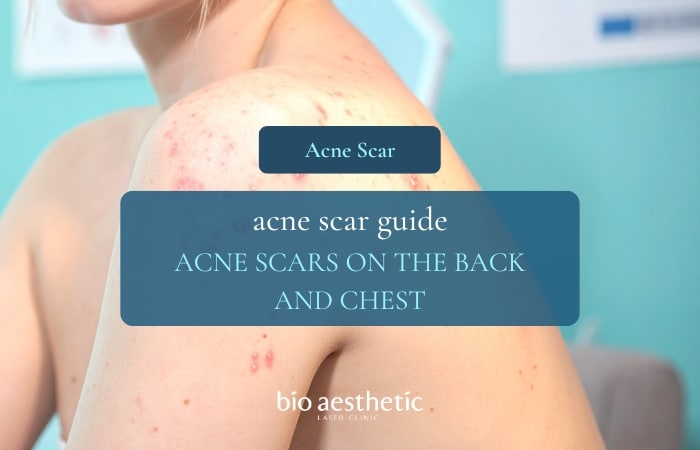
Acne scars on the back and chest behave differently from facial scars. Thicker skin, higher tension, and slower healing mean treatment plans, and downtime must be adjusted. This guide explains why protocols differ and what to expect.
At a Glance
- Body skin is thicker and heals more slowly than facial skin.
- Back and chest scars often need lower laser density and wider spacing.
- Downtime is usually longer for body areas compared to the face.
- Subcision and fractional CO₂ can be used, but with modified protocols.
- Aftercare is more critical to prevent friction-related irritation and pigmentation.
Why Back & Chest Acne Scars Are Treated Differently
Although acne scars share the same underlying cause — inflammation damaging collagen — the back and chest present unique challenges compared to the face:
- Thicker dermis: Body skin requires deeper or repeated stimulation for visible improvement.
- Higher tension: Constant stretching from movement can slow collagen remodelling.
- Friction & sweat: Clothing and perspiration increase irritation risk during recovery.
- Higher PIH risk: Pigmentation changes are more common on the trunk if aftercare is inadequate.
Face vs Back & Chest: Treatment Protocol Differences
| Factor | Face | Back & Chest |
|---|---|---|
| Skin thickness | Thinner, more elastic | Thicker, denser collagen |
| Healing speed | Faster (better blood supply) | Slower, especially on the back |
| Laser settings | Higher density possible | Lower density, conservative passes |
| Downtime | 5–7 days typical | 7–14 days depending on depth |
| PIH risk | Moderate | Moderate to higher if aftercare lapses |
Can CO₂ or Subcision Be Done on the Back?
Yes — but with adjustments.
- Fractional CO₂ laser: Often used at lower density and energy per session, with more sessions spaced further apart. Learn more about fractional CO₂ laser for acne scars.
- Subcision: Useful for tethered rolling scars on the back, though bruising and swelling may last longer than on the face. See subcision for acne scars.
Combination approaches are common, but progress is typically more gradual compared to facial scars.
Aftercare Differences for Body Acne Scars
Post-treatment care for the trunk focuses on minimising friction, sweat, and sun exposure:
- Wear loose, breathable clothing for 7–10 days.
- Avoid workouts, swimming, and saunas until skin settles.
- Shower gently; avoid scrubs or loofahs.
- Apply broad-spectrum sunscreen if the area is exposed.
- Do not pick scabs or micro-crusts — this increases PIH risk.
Frequently Asked Questions
Can CO₂ laser be done on the back?
Yes. Fractional CO₂ can be used on back acne scars, but settings are usually more conservative and sessions are spaced further apart due to thicker skin and slower healing.
Is downtime longer for body acne scars?
Generally, yes. Most patients experience 7–14 days of redness or crusting on the back or chest, compared to around a week on the face.
Are results slower on the back than the face?
Improvement is often more gradual on the body because collagen turnover is slower. Multiple sessions are usually required.
Does subcision work on back scars?
It can be effective for tethered rolling scars, but bruising may be more pronounced and last longer compared to facial areas.
Is pigmentation more likely on the chest?
The chest is more prone to pigmentation changes if exposed to sun or friction during healing, making strict aftercare essential.
Can I treat face and back scars together?
Sometimes, but many protocols stage treatments to manage downtime and allow proper recovery for each area.
Planning Treatment for Body Acne Scars
Back and chest acne scars require patience and tailored protocols. Understanding the differences helps set realistic expectations and avoid unnecessary complications.
Not sure which path fits your scars? See acne scar removal in Singapore (options, sessions & prices).
Doctor reviewed by Dr Vijay Sampath, M.B.B.S, M.S (Gen Surg), DNB (Gen Surg), MRCS (Edinburgh). Last reviewed: December 2025.