

- Lowest-risk choice on day 0: Easy walking and gentle mobility
- Most common “pause” window: Avoid strenuous exercise for about 24 hours (doctor advice varies by plan)
- Biggest early risks: Heat, heavy straining, face-down positions, and rubbing treated areas
- When in doubt: Treat the first day as “cool, calm, upright”
- Review trigger: If you feel uneven movement or unexpected tightness as effects settle
1) Why exercise timing matters
The first day is mainly about reducing avoidable variables while the treatment settles.
Strenuous exercise raises heart rate, blood flow, body temperature, and muscle activity; together, these can increase swelling, aggravate bruising, and make it easier to accidentally rub or press on treated areas when you’re sweating or towel-wiping.
You don’t need to “do nothing,” but it’s worth being intentional for the first 24 hours.
If you want the bigger picture on what affects outcomes (and how different areas are approached), you can start with the full guide to botulinum toxin injections in Singapore
, then use this article as your practical workout timeline.
2) What’s generally safe vs what to pause (quick guide)
Think in terms of intensity and posture. Activities that keep you cool, upright, and low-impact are usually the easiest to fit into day 0, while heavy exertion, heat exposure, and prolonged face-down positions are the things most people postpone until at least the next day.
| Activity type | Same day (0–6 hours) | Same day (6–24 hours) | After ~24 hours |
|---|---|---|---|
| Easy walking / gentle mobility | Usually OK | Usually OK | OK |
| Light stretching (upright, no pressure on face) | Prefer to keep it gentle | Often OK if you stay cool | OK |
| Strength training (moderate/heavy) | Avoid | Usually avoid | Often OK |
| HIIT / running / spin | Avoid | Usually avoid | Often OK |
| Hot yoga / sauna / steam | Avoid | Avoid | Consider waiting longer if you swell easily |
| Face-down positions (e.g., long downward dog) | Avoid | Usually avoid | Often OK |
3) A realistic timeline you can actually follow
Instead of obsessing over a single “magic hour,” use a staged plan. The goal is to keep the first day simple, then return to your usual training once your risk of accidental pressure, rubbing, and excessive heat is lower.
| Time window | What to do | What to avoid | Why |
|---|---|---|---|
| 0–6 hours | Stay upright, keep cool, light walking if needed | Gym, heavy lifting, intense cardio, rubbing/massaging treated areas | Reduces swelling/bruising risk and accidental pressure |
| 6–24 hours | Gentle movement, normal daily activities, hydration | HIIT, hot yoga, sauna/steam, heavy straining, face-down holds | Heat and exertion can aggravate bruising and encourage rubbing |
| After ~24 hours | Return to normal workouts gradually | If you bruise easily, delay high heat or very intense sessions | Most people can resume exercise without issue |
4) Aftercare that matters most for gym-goers
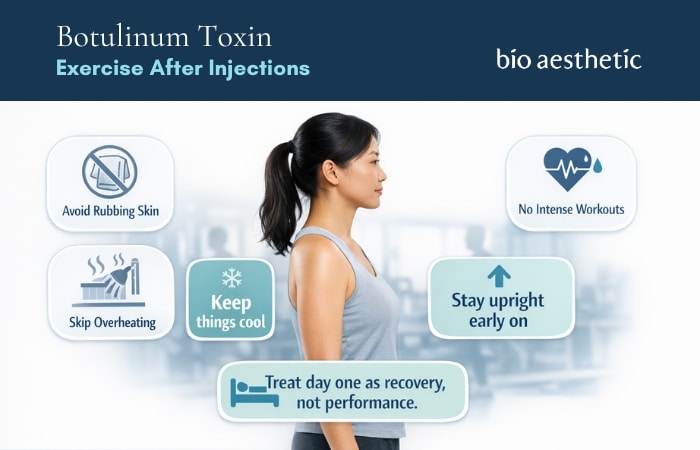
If you’re the kind of person who trains most days, aftercare is less about complicated rules and more about avoiding the handful of habits that commonly cause trouble: rubbing treated areas (especially when towel-drying sweat), overheating too soon, and doing intense sessions that leave you flushed and tempted to press on the skin.
Keep things cool, stay upright early on, and treat the first day as a simple recovery day rather than a performance day.
For a clinician-written explanation of immediate post-treatment precautions, the American Academy of Dermatology summarises common do’s and don’ts in its public guidance on botulinum toxin therapy.
5) Special note if you treated the shoulders/trapezius area
If your plan involved the trapezius region, workouts that heavily recruit the upper traps—such as heavy shrugs, upright rows, or aggressive overhead work—are the ones most people pause a bit longer, simply because that area can feel tender and you may tighten or rub the region without realising.
If you’re exploring trapezius-focused treatment (often called Traptox/Barbie shoulder slimming).
6) When you should review instead of “pushing through”
Most people do not need an urgent review, but it’s sensible to check in if you notice unexpected asymmetry, a feeling of tightness that doesn’t match your usual post-treatment experience, or if you’re unsure whether a specific training plan is appropriate for the areas treated.
A review is not about “doing more”; it’s about confirming that your recovery and return-to-exercise plan matches your goals and anatomy.
Side effects & safety considerations
Mild swelling, redness, or bruising can happen and is usually temporary. If you bruise easily, the biggest practical tip is to avoid heat and intense exertion on day 0, because sweating and towel-wiping can irritate the skin and make bruising look more obvious.
If you develop significant pain, vision changes, or anything that feels unusual for you, follow your doctor’s advice promptly.
If you’re unsure what’s safe for your workout routine, a doctor-led plan can help you time training around your treatment so results stay natural and predictable.
Frequently Asked Questions
1) Can I exercise the same day after injections?
Light activity like gentle walking is often fine, but most people avoid strenuous workouts on the same day to reduce heat, swelling, and accidental rubbing.
2) How long should I wait before going back to the gym?
A common approach is to wait about 24 hours before returning to normal training, then ease back in if you bruise easily or treated multiple areas.
3) Is it okay to do yoga?
Gentle stretching is usually easier to fit in than hot yoga or long face-down holds. If your class is intense or heat-based, it’s safer to postpone it.
4) What about running or HIIT?
High-intensity cardio increases heart rate, heat, and sweating, so many people pause it until the next day.
5) Can exercise make results wear off faster?
Exercise doesn’t usually “cancel” results, but very strong, frequent muscle use can influence how quickly movement returns for some individuals.
6) Can I lift weights?
Light lifting may be fine after the first day, but heavy straining on day 0 is commonly avoided to reduce pressure and bruising.
7) Does sweating affect results?
Sweating mainly increases the chance you’ll wipe or rub the area, and it can make bruising look worse. Keeping cool on day 0 is the simplest strategy.
8) What should I avoid touching or doing to my face?
Avoid rubbing or massaging treated areas, especially when removing makeup, washing, or wiping sweat.
9) If I treated my trapezius, can I train shoulders?
Many people pause heavy trap-dominant movements briefly and return gradually, especially if the area feels tender.
10) When should I book a review?
If you notice uneven movement, unexpected tightness, or you need help planning training around the treated areas, a review can clarify the safest timeline.
Last reviewed by Dr. Vijay Sampath, M.B.B.S, M.S (Gen Surg), DNB (Gen Surg), MRCS (Edinburgh) — February 2026