Aesthetic Clinic Orchard

Bio Aesthetic Laser Clinic — Orchard
Palais Renaissance, 390 Orchard Road #03‑01,
Singapore
238871
Tel: 6333 4566 | WhatsApp Us
This page is educational and does not promote any specific product or brand.
Important: Dermal fillers used for nose reshaping are prescription-only treatments in Singapore. They can only be prescribed and administered by a registered doctor after a face-to-face consultation. Public sale or use without proper medical supervision is not allowed.
In Singapore, nose fillers are a popular option for individuals who want a more defined nose bridge and tip without surgery.
Instead of implants or bone reshaping, a soft gel-like dermal filler is injected in precise points to create a straighter, higher and more refined-looking nose profile.
This guide explains how nose fillers work, what they can realistically achieve, how they compare with nose thread lifts and surgical rhinoplasty, and what to know about safety, side effects, costs and aftercare — so you can decide, together with your doctor, whether this treatment is appropriate for you.
Nose fillers (sometimes called a “non-surgical nose job”) use injectable dermal fillers to reshape the nose. Most nose fillers in Singapore are based on
hyaluronic acid (HA), a substance naturally found in the body that helps retain moisture and volume.
When carefully injected along the nose bridge and tip, the filler can:
Unlike surgical rhinoplasty, there is no cutting of bone or cartilage. The nose structure remains the same — the filler sits above it, acting like a sculptable cushion to shape light and shadow.
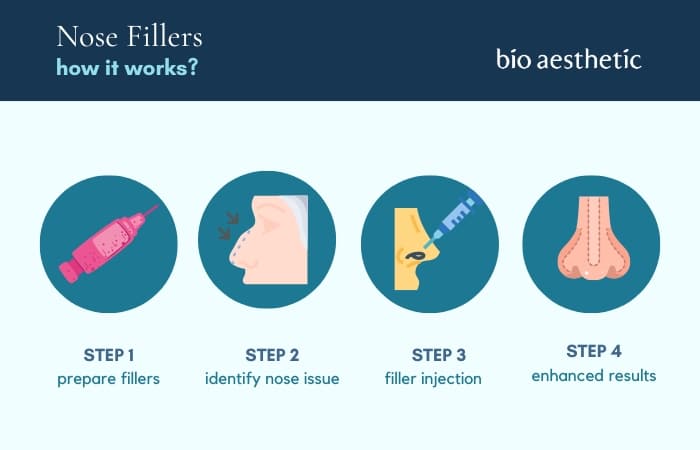
During treatment, the doctor injects small amounts of filler using a fine needle or blunt cannula along the bridge and/or tip. The filler integrates with surrounding tissues, holding shape and volume for a period of time before gradually breaking down.
In many cases, HA-based fillers can be adjusted or dissolved by a doctor if:
Your doctor will assess your nose from the front and side, consider your facial proportions, skin thickness and previous procedures (e.g. nose thread lift, prior fillers, surgery), and design a safe, natural-looking treatment plan.
Nose fillers are best for subtle structural refinement, not dramatic reshaping. They are particularly useful for common Asian nose concerns:
| Nose Feature / Concern | How Nose Fillers Can Help | What to Understand |
|---|---|---|
| Low or flat nose bridge | Fillers can build up height along the bridge to make it look straighter and more defined. | Creates the impression of a taller nose; does not make the nose physically narrower at the bone. |
| Droopy or undefined tip | Strategic filler at the tip and columella can improve tip support and projection. | Results must remain conservative to avoid looking “overfilled” or unnatural from the side. |
| Small hump or bump on profile | Filler above and below the hump can visually smooth the profile. | Ideal for mild to moderate irregularities; larger humps may still need surgery if correction is desired. |
| Mild asymmetry | Filler can be used more on one side to improve symmetry in front view. | Natural faces are not perfectly symmetrical; aim is improvement, not perfection. |
| Depressed areas after previous procedures | Careful refilling can mask dents or contour issues. | Requires very experienced injectors, especially if there are old threads, implants or scar tissue. |
Because fillers add volume, they are not suitable for patients who already feel their nose is too large or too wide from the front. In such cases, your doctor may discuss alternatives such as nose thread lift, other face-contouring options, or referring for surgical opinion.
Suitability is always determined during medical consultation, but in general, nose fillers may be considered for:
You may not be suitable for nose fillers if you:
Your doctor will also review your medical history, medications (e.g. blood thinners), previous nose surgeries, nose threads or implants, and discuss whether a non-surgical or surgical approach is safer and more appropriate.
Patients often ask, “Should I do threads, fillers or surgery for my nose?” Each option has its own role. Many people are surprised to learn that a combination approach (for example, nose thread lift for structure plus a small amount of filler) may sometimes give the most balanced result — but this always depends on your anatomy and safety considerations.
| Aspect | Nose Fillers | Nose Thread Lift | Surgical Rhinoplasty |
|---|---|---|---|
| Type of procedure | Non-surgical injections using dermal filler gel. | Non-surgical insertion of dissolvable threads to lift and support the nose. | Surgical operation to reshape bone, cartilage and soft tissues. |
| Best for | Adding height, smoothing small humps, refining tip and minor asymmetry. | Defining bridge and tip, adding support, improving projection with less volume. | Major shape changes, large hump removal, significant narrowing or functional correction. |
| Longevity | Often around 9–18 months; varies by filler, area and metabolism. | Threads gradually dissolve over months; effect may last around 1–2 years. | Structural changes are generally long-lasting; nose still changes with age. |
| Reversibility | Most HA nose fillers can be dissolved by a doctor if indicated. | Cannot be “dissolved” instantly; effect fades as threads dissolve. | Not easily reversible; revision surgery may be required if changes are not desired. |
| Downtime | Usually mild swelling, redness or bruising for a few days. | Similar or slightly more swelling; temporary tightness at thread entry points. | More significant downtime; swelling and bruising can last weeks, with dressings or splints. |
| Key risks | Bruising, swelling, unevenness, rare vascular complications (e.g. skin or vision issues). | Bruising, swelling, visible threads, infection, contour irregularities. | Surgical risks (anaesthesia, infection, scarring, prolonged swelling, revision surgery). |
| When it may be preferred | Patients wanting reversible, adjustable nose refinement without surgery. | Patients wanting structural lift with less added bulk and defined tip. | Patients requiring major structural or functional correction and are comfortable with surgery. |
If you are unsure whether nose fillers, nose thread lift, or surgical rhinoplasty is more suitable, a consultation with an experienced aesthetic doctor is the safest starting point. Your doctor can also advise if combination treatments are appropriate or if a referral to a surgeon is better.

Your visit typically starts with a detailed consultation. The doctor will examine your nose from multiple angles, review your medical history, ask about previous procedures and understand what you hope to achieve. This is also the time to discuss alternatives such as nose thread lift and whether you’ve had fillers elsewhere on the face.
Standardised photographs may be taken to document your baseline and help with planning. The doctor may explain where filler can realistically be placed, what changes are feasible and where limitations lie — especially if you have a very flat bridge, very thick skin or a prominent hump.
The doctor injects small amounts of filler at targeted points along the bridge and/or tip using a fine needle or cannula. You may feel pressure, pushing or mild discomfort, but many fillers also contain local anaesthetic to improve comfort.
Throughout the procedure, your doctor will continually reassess shape, height and symmetry from various angles, adding micro-adjustments to avoid overfilling.
All medical procedures, including nose fillers, carry risks. While many side effects are mild and temporary, it is important to understand potential complications and how your clinic approaches safety.
Because the nose has a rich blood supply that connects to important vessels around the eyes, serious vascular complications — such as skin injury or vision issues — are rare but recognised risks of nose fillers.
This is why many patients prefer to be treated by doctors who:
If you notice severe pain, colour changes, sudden vision changes or other worrying symptoms after any filler procedure, seek urgent medical attention immediately.
Most individuals can return to work and daily activities soon after nose filler treatment, but minor downtime is still expected.
Your doctor will give you personalised guidance based on your treatment plan, medical history and lifestyle.
Nose filler longevity varies from person to person, but many patients find their results remain noticeable for around 9–18 months before gradually softening. Some retain subtle changes even longer.
Durability depends on:
Top-up sessions may be recommended to maintain your preferred nose shape, but the timing and frequency should always be personalised rather than fixed.
As a prescription-only injectable treatment, exact nose filler pricing is usually confirmed after a medical consultation, once your doctor has assessed your nose and designed an appropriate plan.
In Singapore, nose fillers are commonly charged per syringe, with total cost depending on how much product is required to safely achieve your goals.
| Treatment Scenario | What It Typically Includes | Factors That Influence Cost |
|---|---|---|
| Simple nose bridge refinement | One syringe used mainly along the bridge for modest height and definition. | Amount of filler used, product characteristics, complexity of your baseline anatomy. |
| Bridge + tip shaping | Filler along the bridge and carefully at the tip/columella for projection and support. | Extra time, additional injection points, higher product volume needed for stable tip support. |
| Touch-up or refinement session | Smaller amounts of filler used to correct minor asymmetry or refine contour. | Whether a full syringe is required, time since previous treatment, current nose shape. |
| Combination with nose thread lift | Threads for structural lift plus small amounts of filler to fine-tune contour. | Whether both procedures are done in one sitting, number of threads and filler volume used. |
During consultation, your doctor will explain your personalised treatment plan and provide a clear breakdown of costs before any procedure proceeds.
Patients often focus only on “How much?” and “How long will it last?” — but there are other important questions that many people don’t think to ask:
Having a frank, detailed conversation with your doctor helps align expectations and ensures you are comfortable with both the benefits and the risks before proceeding.

No two noses are identical, and the same amount of filler can look very different from one patient to another. A safe, natural-looking outcome depends on:
If you are considering nose fillers in Singapore and would like to understand whether this treatment, a nose thread lift, or surgery might suit you better, a face-to-face consultation with a doctor is the safest first step.
Every nose and face is unique. A personalised consultation lets you discuss your goals, understand your anatomical limitations,
and explore non-surgical and surgical options in a safe, doctor-led setting.
Book a consultation with our doctors at Bio Aesthetic Laser Clinic (Orchard or Tampines) to explore your options for nose and facial contouring.
A non-surgical nose filler uses injectable dermal fillers to refine the nose bridge and tip without cutting bone or cartilage.
The filler is placed in precise points to add height, smooth small humps and improve definition, with results that are usually visible immediately.
Many patients find that nose fillers last around 9–18 months, though this varies with filler type, injection plane and individual metabolism.
Over time, the filler gradually breaks down and the nose slowly returns closer to its original shape.
Most commonly used nose fillers are hyaluronic-acid–based and can be dissolved by a doctor using a specific enzyme if medically appropriate.
However, reversal is still a medical procedure and should not be relied on as a casual “undo” button — the aim is always to treat conservatively and safely from the start.
Nose fillers are widely performed but, like all injectable treatments, carry risks. Common effects include temporary swelling and bruising.
Rare but serious complications such as vascular events can occur, which is why it is important to be treated by experienced doctors in a clinic with proper protocols and emergency readiness.
Neither is universally “better” — they work differently. Fillers add volume and are useful for smoothing humps and building height,
while nose threads provide internal support and lift with less added bulk. Your anatomy, goals and risk profile will guide whether fillers, threads or a combination is more suitable.
Nose fillers can sometimes camouflage a mild hump or improve minor asymmetry by filling above, below or on one side of the nose.
However, they cannot correct severe structural deviation or functional breathing problems; such issues may require surgical assessment.
This depends on your starting anatomy and desired result. Some patients achieve their goals with roughly one syringe for the bridge,
whereas others may need additional product for the tip or to correct irregularities. Your doctor will advise after examining your nose in person.
It may be possible, but requires extra caution. Threads, implants and scar tissue can change the anatomy and affect filler placement.
Your doctor will need to assess your nose carefully, and in some cases may recommend imaging, further observation or referral before proceeding.
Most people experience a few days of mild swelling, redness or small bruises. Makeup can usually be worn after a short period if the skin is intact and your doctor agrees.
You should avoid pressing the nose, doing very intense exercise or using saunas immediately after treatment.
Nose fillers are generally not recommended for those who are pregnant or breastfeeding, have active infections around the nose,
have had serious complications from fillers previously, or who have unrealistic expectations. Suitability must always be confirmed during a medical consultation.
Doctor-reviewed by Dr. Vijay Sampath, M.B.B.S, M.S (Gen Surg), DNB (Gen Surg), MRCS (Edinburgh). Last reviewed: December 2025.
Visit our Aesthetic Clinic Orchard or Aesthetic Clinic Tampines for personalised acne scar treatment and comprehensive aesthetic care.
Tel: 6333 4566 | WhatsApp Us

Tel: 6782 2777 | WhatsApp Us
Call Us at +65 6333 4566 • hello@bioaesthetic.com.sg

Bio Aesthetic Laser Clinic is a bespoke aesthetic clinic in Singapore specialising in treatments such as:
MORE QUESTIONS?
Feel free to Call Us or WhatsApp Us. We are more than happy to address your concerns