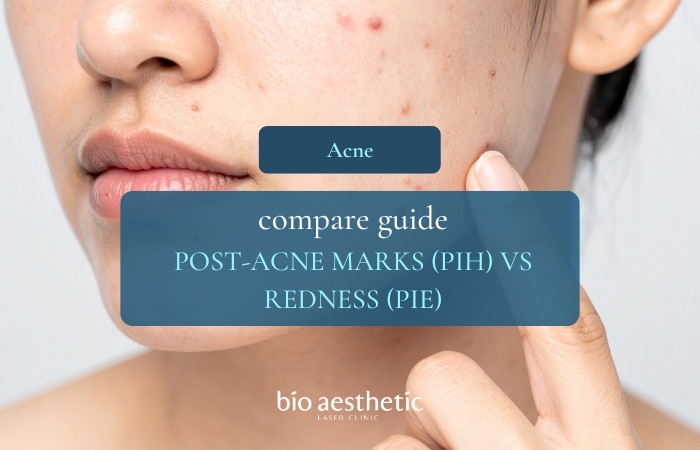
- PIH = brown marks caused by excess melanin after acne inflammation.
- PIE = red or pink marks caused by dilated or damaged blood vessels.
- PIH darkens easily under Singapore’s strong UV exposure.
- PIE looks redder in heat, workouts, showers and humid weather.
- Neither PIH nor PIE is a true scar, but both can linger if triggers continue.
TL;DR: Brown post-acne spots (PIH) and red marks (PIE) may look similar, but they come from different processes in the skin. In Singapore’s hot, humid and UV-intense climate, both can last longer than expected. Understanding which one you have helps you choose gentler, more effective steps and avoid products that make marks worse.
🔍 Why It Matters to Distinguish PIH from PIE
Many people assume all post-acne marks are pigmentation. This often leads to using strong brightening acids on redness (PIE), or relying only on calming products for brown spots (PIH).
In both cases, results are slow and irritation can increase.
In Singapore, where UV levels are high year-round and humidity is constant, mis-treating PIH or PIE can prolong marks for months.
Acne that keeps flaring, mask friction, sweat, hormonal changes and cystic breakouts all contribute to new marks.
Knowing whether your main concern is PIH or PIE gives you a clearer plan for what to do at home and when to consider a doctor-led review.
🟤 What Is PIH (Brown Marks)?
Post-Inflammatory Hyperpigmentation (PIH) is the flat brown or tan discolouration that remains after acne heals.
When a pimple inflames the skin, melanocytes (pigment cells) become more active and produce extra melanin in the area.
As a result, even after the pimple disappears, the brown “shadow” can remain for weeks or months.
PIH is especially common in medium to darker Asian skin tones and can appear on the face, jawline, chest and back. For example, those who struggle with body or back acne often notice a trail of dark marks where breakouts used to be.
Because PIH is melanin-based, sunlight is the biggest factor affecting how dark it becomes and how slowly it fades.
In Singapore, even short walks between buildings or sitting by a window can deepen PIH if sun protection is inconsistent.
🔴 What Is PIE (Redness)?
Post-Inflammatory Erythema (PIE) is different. Instead of melanin, PIE is caused by dilated or fragile blood vessels close to the skin’s surface after inflammation.
These small vessels remain widened or irritated even after the pimple itself settles, creating pink, red or sometimes purplish spots.
PIE tends to be more obvious in fair or sensitive skin, but anyone can develop it after inflamed acne, especially cystic breakouts or “maskne” around the chin and jawline.
The redness often becomes brighter after a hot shower, exercise or time spent outdoors in Singapore’s heat, because warmth naturally dilates blood vessels.
📊 PIH vs PIE: Key Differences
At a glance, both can look like “marks left by pimples”, but the underlying mechanisms are different:
| Feature | PIH | PIE |
|---|---|---|
| Main cause | Melanin overproduction after inflammation | Dilated or damaged blood vessels after inflammation |
| Typical colour | Brown, tan or greyish | Pink, red or purplish |
| Worsened by | Sunlight and UV exposure | Heat, hot showers, workouts, friction |
| Most common in | Medium to darker Asian skin tones | Fair or sensitive skin |
| Improves with | Consistent SPF and gentle brightening | Barrier repair and calming care |
| Is it scarring? | No | No |
🌞 Why Singapore’s Climate Makes Marks Look Worse

Singapore’s UV index is high throughout the year. This means PIH can darken quickly, even with short periods outdoors.
UV rays stimulate melanocytes further, reinforcing the pigmentation loop and slowing fading.
Humidity also plays a role. Sweat and sebum can irritate healing skin and prolong inflammation, especially if you are frequently outdoors or commuting.
For PIE, heat is the main issue. Warm weather and hot showers cause blood vessels to dilate naturally.
When you already have dilated vessels from previous inflammation, they can appear even redder.
Combined with mask friction, chin straps or tight collars, PIE on the cheeks, jawline and chin can look more prominent in Singapore than it would in a cooler climate.
🧴 Supporting PIH and PIE Gently at Home
For brown marks (PIH), the foundation of care is sun protection.
A broad-spectrum sunscreen, used every day and reapplied as needed, makes the single biggest difference to whether PIH stays the same, darkens or gradually lightens over time.
On top of that, ingredients such as niacinamide, azelaic acid, arbutin or vitamin C (if your skin tolerates it) can slowly brighten uneven tone. Gentle chemical exfoliation, or professionally supervised chemical peels, may also support the fading process.
For redness (PIE), the priorities are a calm routine and a strong barrier. Look for ceramides, centella asiatica, panthenol and other soothing ingredients.
Keeping your skincare simple helps reduce the risk of further irritation. Physical scrubs and overly strong acids can make PIE appear worse, especially when combined with Singapore’s heat and humidity.
Reducing friction from masks and avoiding very hot showers will also support gradual improvement.
⏱ Healing Timeline: What to Expect
Everyone’s skin heals at a different pace, but most people notice some degree of improvement in both PIH and PIE within the first few weeks of consistent care.
| Timeframe | PIH (Brown marks) | PIE (Redness) |
|---|---|---|
| 2–4 weeks | First signs of lightening with regular SPF | Redness begins to look less intense |
| 6–8 weeks | More even tone, especially on smaller spots | Red areas flatten and slowly blend with surrounding skin |
| 3–6 months | Most superficial PIH can fade significantly | PIE may resolve if there is no repeated irritation |
🩺 When to Consider a Doctor-Led Plan
If your PIH or PIE has not changed after 8–12 weeks of consistent, gentle care, or if new marks appear every month because of fresh acne, it can be helpful to seek a medical assessment. A clinician can differentiate between PIH, PIE, early pigmentation scarring and true acne scars and recommend a personalised plan that suits your skin type.
When acne is still active, managing the underlying breakouts is essential. A doctor-led acne management plan can help reduce new inflammation and breakouts, especially for persistent or cystic acne, which is more likely to leave marks. For more information about deeper or long-standing concerns, you can also refer to our pages on acne scars and acne scar treatment options, as well as dedicated information on cystic acne and back acne.
Last reviewed by Dr. Vijay Sampath, M.B.B.S, M.S (Gen Surg), DNB (Gen Surg), MRCS (Edinburgh) — November 2025
FAQs: PIH vs PIE in Singapore
How can I quickly tell if my mark is PIH or PIE?
The easiest way is to look at the colour. Brown or tan marks are usually PIH and relate to pigment. Pink or red marks are more likely PIE and relate to blood vessels. PIE also tends to look redder when you are hot or have just exercised.
Why do my brown marks get darker even when I spend most of my time indoors?
UV light can pass through windows and reflect off surfaces, so indoor exposure still affects PIH. In Singapore’s strong sun, even short exposures without protection can deepen existing pigmentation.
Why does my redness (PIE) turn bright after a shower or workout?
Heat dilates blood vessels near the surface of the skin. If those vessels are already sensitised after acne, they will appear redder whenever your body temperature rises.
Can PIE turn into PIH?
Yes. If an area with PIE is repeatedly irritated, picked or exposed to strong treatments, the inflammation can stimulate extra melanin, leading to brown PIH on top of the redness.
Can I have PIH and PIE at the same time from the same pimple?
Very often, yes. A single inflamed breakout can leave both vascular redness and pigment. This is why some spots look both red and brown while they are healing.
Should I exfoliate if I mainly have redness?
Over-exfoliation is not recommended for PIE. Gentle chemical exfoliation may help with texture in some cases, but harsh scrubs, frequent acids or strong retinoids can worsen redness and sensitivity, especially in Singapore’s heat.
Will my PIH or PIE become permanent?
In most cases, both PIH and PIE fade over time. However, poor sun protection, frequent new breakouts and ongoing irritation can significantly delay this process. Consistency with SPF and a calm routine is essential.
Do these marks mean I will definitely develop acne scars?
No. PIH and PIE are considered post-inflammatory marks rather than true scars. Scars involve deeper changes in collagen and texture. That said, severe or repeated inflammation can increase the risk of scarring, especially if acne is not well controlled.
Why aren’t my marks fading even after several months?
Common reasons include inconsistent sunscreen, ongoing acne, using too many active products at once, or irritation from skincare and lifestyle factors. A medical review can help identify what is holding back your progress.
What should I do if new marks keep appearing every week?
New PIH and PIE usually indicate ongoing acne inflammation. In this case, the priority is to manage the acne itself through a structured plan. You can learn more about options in our acne information page.