
Dermal Fillers
Facial enhancements, Treat Acne Scars, Nose Fillers, Chin Fillers & Eye Fillers
Cost, Safety, Results and Downtime


What Are Dermal Fillers?
Dermal fillers are doctor-administered injectable treatments commonly used to restore facial volume, support contours, and soften selected lines. On this page, the focus is on hyaluronic acid dermal fillers, which are often chosen for areas such as the cheeks, chin, lips, jawline, and under-eyes.
Dermal fillers may be considered for:
- Volume loss in hollow or sunken areas
- Facial contouring such as the cheeks, chin, jawline, or lips
- Selected lines and folds where soft-tissue support is one treatment goal
- Facial balance in selected cases
Suitability depends on facial proportions, treatment goals, anatomy, and product selection.
Dermal Fillers at a Glance
Treatment Focus
Volume loss, facial contouring, selected lines, and structure support in areas such as cheeks, chin, lips, jawline, and under-eyes.
Downtime
Usually limited, though temporary swelling, bruising, or tenderness may occur.
Session Planning
Often performed as a single session, with review depending on area treated and filler longevity.
Doctor Review
Suitability depends on facial proportions, treatment goals, anatomy, and product selection.
How Do Dermal Fillers Work?
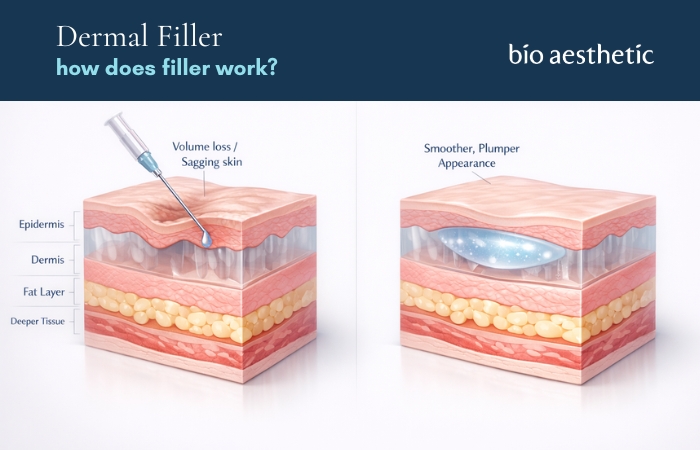
Most dermal fillers used for facial enhancement are based on hyaluronic acid, a substance naturally found in the skin. Hyaluronic acid is commonly associated with hydration and soft-tissue support.
When dermal fillers are placed into selected treatment areas, they help support volume, contour, and structure. Face fillers are commonly considered for:
- hollow or sunken areas
- facial definition
- selected lines or folds
Hyaluronic acid fillers also attract and retain water, which can help the treated area look fuller over time. The exact effect depends on the product used, the area treated, and the amount placed.
At Bio Aesthetic Laser Clinic Singapore, dermal filler treatment is planned according to facial proportions, treatment goals, and doctor assessment.
Benefits of Dermal Fillers
- Supports facial contouring in areas such as the lips, chin, and nose
- Non-permanent enhancement, with reversibility possible for selected hyaluronic acid fillers
- Restores volume in hollow or depressed areas
- May improve selected acne scars, lines, and wrinkles depending on the area and treatment plan
- Can be combined with other doctor-led treatments in selected cases
Procedure Details
- Doctor assessment based on facial proportions, treatment goals, and suitability
- Dermal filler treatment is often completed in about 30 minutes, depending on the area treated
- Downtime is usually limited, though temporary swelling or bruising may occur
Recommended Skin Type for Face Fillers

Facial Wrinkles
May be considered for selected facial lines and folds where soft-tissue support is one treatment goal.

Ageing Skin
Often discussed for patients who want facial support and a fresher-looking appearance without surgery.

Volume Loss
Commonly considered for hollow or sunken areas that may benefit from restored facial volume.
Face fillers are a non-surgical treatment commonly used to support volume, contour, and facial balance in selected areas.
Dermal Filler Treatment Details
| Treatment Time | About 30 minutes |
| Longevity | 6 to 12 months |
| Review Timing | Consult Doctor |
| Downtime | Usually limited |
| Price | Contact us |
Treatment planning depends on the area treated, the product selected, and the facial proportions being addressed. A review is useful to assess longevity and future touch-up timing.
Dermal Fillers in Singapore
Dermal fillers are commonly used to support facial volume, contour, and soft-tissue balance in areas affected by volume loss or reduced definition.
Common treatment areas include the lips, cheeks, chin, jawline, and selected facial folds. They are often chosen by patients who want a non-surgical option for facial enhancement while maintaining natural-looking proportions.
Suitability, product choice, and placement should always be guided by doctor assessment and facial anatomy.
Where can I inject Dermal Fillers?
Common Treatment Areas for Dermal Fillers
Cheek Fillers
Cheek fillers are commonly considered for volume loss, flatter cheek contours, or reduced mid-face support. They are often used to support facial proportions and a more lifted-looking mid-face in selected cases.

Commonly Considered For: Cheeks
- mid-face volume support
- facial contour enhancement
- selected age-related volume loss
- often lasts about 6 to 12 months, depending on product and area
Under-Eye / Tear Trough Fillers
Under-eye filler, also known as tear trough filler, is commonly considered for hollowing beneath the eyes where volume support may help soften a tired-looking appearance in selected patients.
Commonly Considered For: Under-Eye Area
- selected under-eye hollowing
- tired-looking eye area
- soft tissue support in suitable anatomy
- doctor assessment is especially important for this area
Lip Fillers
Lip fillers are commonly considered for patients who want more lip volume, definition, or shape support. Treatment is usually planned according to lip proportions and the look being targeted.
Commonly Considered For: Lips
- lip volume support
- lip border and shape definition
- selected asymmetry concerns
- often lasts about 6 to 12 months
Chin Fillers
Chin fillers are commonly used to support chin projection, improve lower-face proportions, and enhance profile balance in selected patients.
Commonly Considered For: Chin
- chin projection support
- facial balance and profile enhancement
- selected lower-face definition
- longevity depends on product and placement
Jawline Fillers
Jawline fillers are commonly considered for lower-face contour support and a more defined jawline outline in selected cases.
Commonly Considered For: Jawline
- jawline contour support
- lower-face definition
- selected structural enhancement
- often chosen for non-surgical contouring
Nasolabial Fold Fillers
Dermal fillers may be considered for selected nasolabial folds where soft-tissue support is one of the treatment goals. Treatment planning depends on facial anatomy and whether direct or indirect support is more appropriate.
Commonly Considered For: Nasolabial Folds
- selected smile-line concerns
- soft tissue support in the lower face
- often planned with facial-balance assessment
- product choice depends on the treatment approach
Dermal Fillers Cost and Price Singapore
Typically, dermal filler pricing in Singapore may start from about S$600 to S$1,200, depending on the area treated, the amount required, and the product selected.In line with healthcare advertising requirements in Singapore, exact dermal filler pricing cannot be publicly displayed.
| Area | Price |
|---|---|
| Dermal Fillers | Enquire for Price |
We believe in personalised care, so each filler plan is tailored rather than one-size-fits-all. Factors that may influence pricing include the number of areas treated, the type of filler selected, and the treatment goals being addressed.
All filler treatments are carried out by licensed doctors in a registered clinic.
CONSULT OUR DOCTOR FOR A BESPOKE SOLUTION
ASK ABOUT DERMAL FILLERSCompare the Different Types of Dermal Fillers
| Type | Hyaluronic Acid Fillers | Calcium Hydroxyapatite Fillers | Polycaprolactone Fillers |
|---|---|---|---|
| Product Example | |
 |
 |
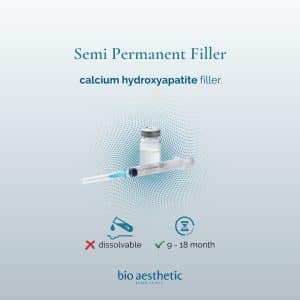
| Category | Dissolvable hyaluronic acid fillers | Semi-permanent fillers (non-dissolvable) | Semi-permanent fillers (non-dissolvable) |
| Longevity | 3 – 18 months | 9 – 18 months | 1 – 2 years |
| Reversible | Yes | No | No |
| Price | Price cannot be publicly displayed | Price cannot be publicly displayed | Price cannot be publicly displayed |
| Key Benefits | Easily reversible if adjustment is needed | Stimulates collagen and provides stronger lift | Longest-lasting option with strong lifting effect |
| Onset of Results | Immediate | Immediate | Immediate |
Why HA Fillers Are Commonly Chosen
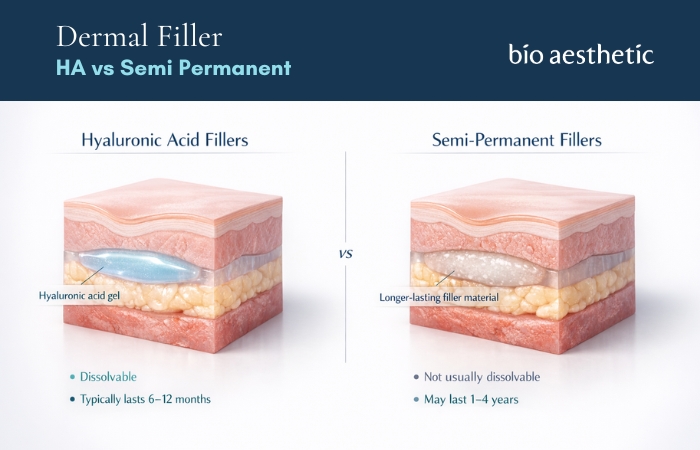
When it comes to face fillers, hyaluronic acid (HA) fillers are commonly chosen because they are versatile, widely used, and reversible in selected cases.
- Reversible treatment for selected HA fillers if adjustment is needed
- Volume and hydration support in hollow or depressed areas
- Suitable for multiple facial areas such as the lips, cheeks, chin, and jawline
- Commonly chosen for flexibility when treatment plans need to be individualised
Compared with semi-permanent fillers, HA fillers usually do not last as long, but this shorter longevity is also one reason some patients prefer them, especially when they want more flexibility in future treatment planning.
Dermal Fillers Side Effects
Dermal filler treatment is generally associated with minimal downtime in many cases, but side effects can still vary depending on the product used, the treatment area, the injection technique, and individual response.
- Mild swelling, redness, or tenderness at the treated area
- Bruising or small injection marks
- A temporary feeling of firmness, fullness, or unevenness as the filler settles
- Short-term puffiness in areas where the skin is thinner or more sensitive
- Temporary sensitivity when touching or pressing the treated area
Most of these effects are temporary and usually improve as the area settles over the following days. Less common but more significant complications can also occur, which is why treatment planning, injection technique, and post-treatment advice should be guided by the doctor.
Dermal Fillers Aftercare Guide
After dermal filler treatment, simple aftercare is usually advised to help the area settle well and to reduce unnecessary irritation.
- Avoid rubbing, pressing, or massaging the treated area unless specifically advised
- Avoid strenuous exercise, excessive heat exposure, and saunas for the first 24 hours
- Keep the treated area clean and avoid unnecessary touching
- Use gentle skincare and avoid irritating active products if the area feels sensitive
- Seek prompt review if swelling, pain, or colour change seems unusual or progressively worsens
Mild swelling or bruising can still occur even with careful aftercare, and the treated area may take several days to settle properly. Specific instructions can vary depending on the area treated and the type of filler used, so doctor guidance remains important.
How to Choose the Right Type of Dermal Filler
The most suitable dermal filler depends on the treatment area, facial anatomy, skin thickness, and whether the goal is soft volume, contour support, or stronger structural definition.
- Softer fillers may be considered for subtle shaping or movement, such as selected lip or under-eye concerns.
- Medium-support fillers may be chosen for areas such as the cheeks or selected folds.
- Firmer fillers may be used for areas needing more structure, such as the chin, jawline, or nose.
- Longevity and reversibility may also influence the treatment plan.
A personalised assessment helps determine the more appropriate filler type and injection plan for your facial proportions and treatment goals.
| Comparison Point | Soft Fillers | Medium Fillers | Firm Fillers |
|---|---|---|---|
| Best For | Lips, selected fine lines | Cheeks, selected smile lines | Chin, jawline, nose |
| Consistency | Soft and flexible | Balanced support | Denser structural support |
| Duration | About 6 to 9 months | About 9 to 12 months | Up to about 12 to 18 months |
| Typical Placement | More superficial placement in selected areas | Mid to deeper placement depending on the area | Deeper structural placement in selected areas |
| Reversible | Selected hyaluronic acid fillers can be reversed | Selected hyaluronic acid fillers can be reversed | Selected hyaluronic acid fillers can be reversed |
| Doctor Assessment | Always required | Always required | Always required |
Am I suitable for Face Fillers?
Who Are Face Fillers For?
- Patients seeking contour support for the lips, chin, jawline, or nose
- Patients with hollow or depressed facial areas
- Patients looking to support volume loss or selected lines and folds
What Kind of Results Can I Expect?
Some swelling, bruising, redness, or tenderness may occur after treatment and usually settles over several days.
Results are often visible soon after treatment, with review timing guided by the doctor.
Can I Use Medisave for Face Fillers?
Face fillers are generally treated as an aesthetic treatment rather than a Medisave-claimable procedure.
FAQ for Dermal Fillers
Yes, it can be administered in the underarms to temporarily reduce excessive sweating by blocking nerve signals to sweat glands.
This treatment is typically not recommended for those who are pregnant, breastfeeding, or have certain neurological conditions. Suitability should always be assessed during a medical consultation. You can book a consultation or learn more about candidacy here.
Botulinum toxin is a prescription-only medical procedure in Singapore. Due to healthcare regulations, treatment pricing must be discussed in-person during a doctor’s consultation.
Yes. Doctors may use botulinum toxin to treat neck lines (platysmal bands) or for trapezius slimming, based on your anatomy and goals. For a deeper understanding of advanced botulinum toxin applications, refer to our full guide.
There’s little to no downtime for most individuals. It’s generally advised to avoid strenuous activity and rubbing the treated area for the first 24 hours.
Yes. Botulinum toxin may be injected into the masseter muscles to reduce muscle tension from clenching or grinding. You can learn more about jaw slimming and medical use of botulinum toxin in our main guide.
Men generally have stronger facial muscles, so they may require higher dosages than women in areas like the forehead or masseter muscles.
Unit requirements vary by facial area and individual muscle strength. For instance, forehead lines might require 10–20 units, while jaw slimming may need 25–50 units per side.
Botulinum toxin is commonly used to relax specific facial or body muscles. In aesthetic treatments, it may help reduce wrinkles, contour the jawline, or address concerns like sweating or teeth grinding. You can read the full guide to botulinum toxin treatments in Singapore to learn more about its use and safety.
Most people begin to see changes in 3 to 7 days, with full effect in about 2 weeks. This may vary depending on the area treated and individual response.
Botulinum toxin treatments are generally not recommended during pregnancy or breastfeeding.
If you are pregnant, planning to conceive, or nursing, it’s important to discuss your medical history with a qualified doctor before considering any treatment. A personalised consultation is necessary to determine suitability.
Botulinum toxin is generally not recommended for individuals under 18 years old. Any treatment for minors would require a full medical consultation, parental consent, and clinical justification. A qualified doctor will assess suitability based on medical need and age-related factors.
Dermal Fillers Near You

Tampines Clinic
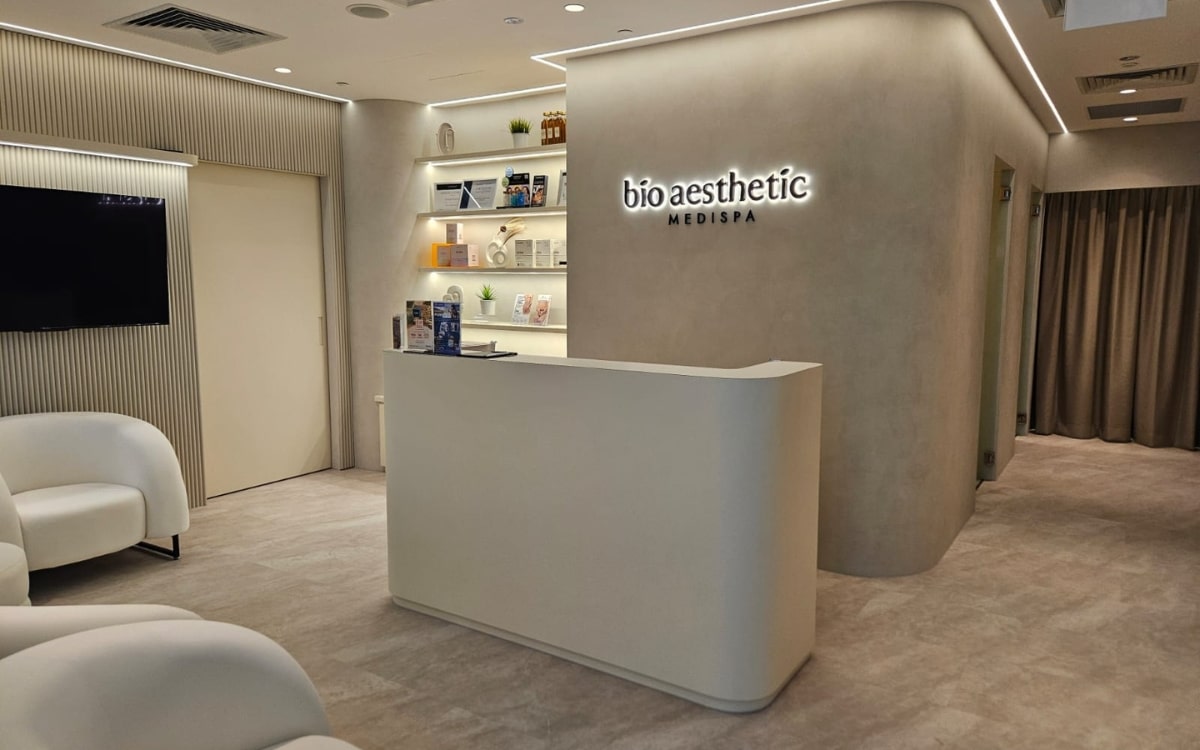
300 Tampines Avenue 5, #04-05
Income @ Tampines Junction, Singapore 529653
Consult our Doctors for Dermal Fillers

Dr Jolenda Ang

Dr Daniel Khaw

Dr Vijay Sampath
Make an Appointment
Call Us Today! +65 6333 4566 • hello@bioaesthetic.com.sg
This site is protected by reCAPTCHA and the Google Privacy Policy and Terms of Service apply.
Disclaimer: The information on this page is provided for general educational and informational purposes only and should not be relied on as medical, diagnostic, or treatment advice. Content may not be exhaustive, may not apply to every individual, and should not replace a consultation with a qualified doctor. While reasonable care is taken in preparing this content, Bio Aesthetic Laser Clinic and its related parties do not accept liability for any loss, damage, or consequences arising from reliance on the information presented on this page. Suitability for any treatment should always be assessed during a proper medical consultation.